

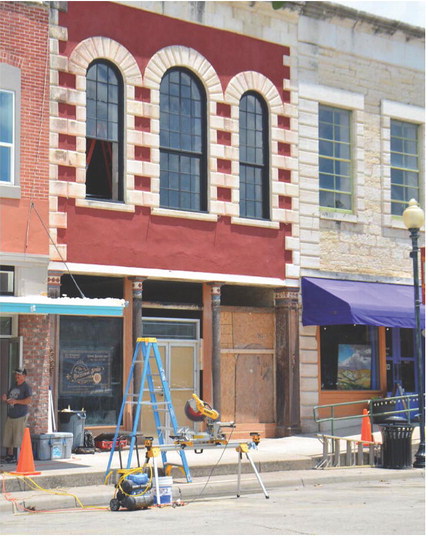
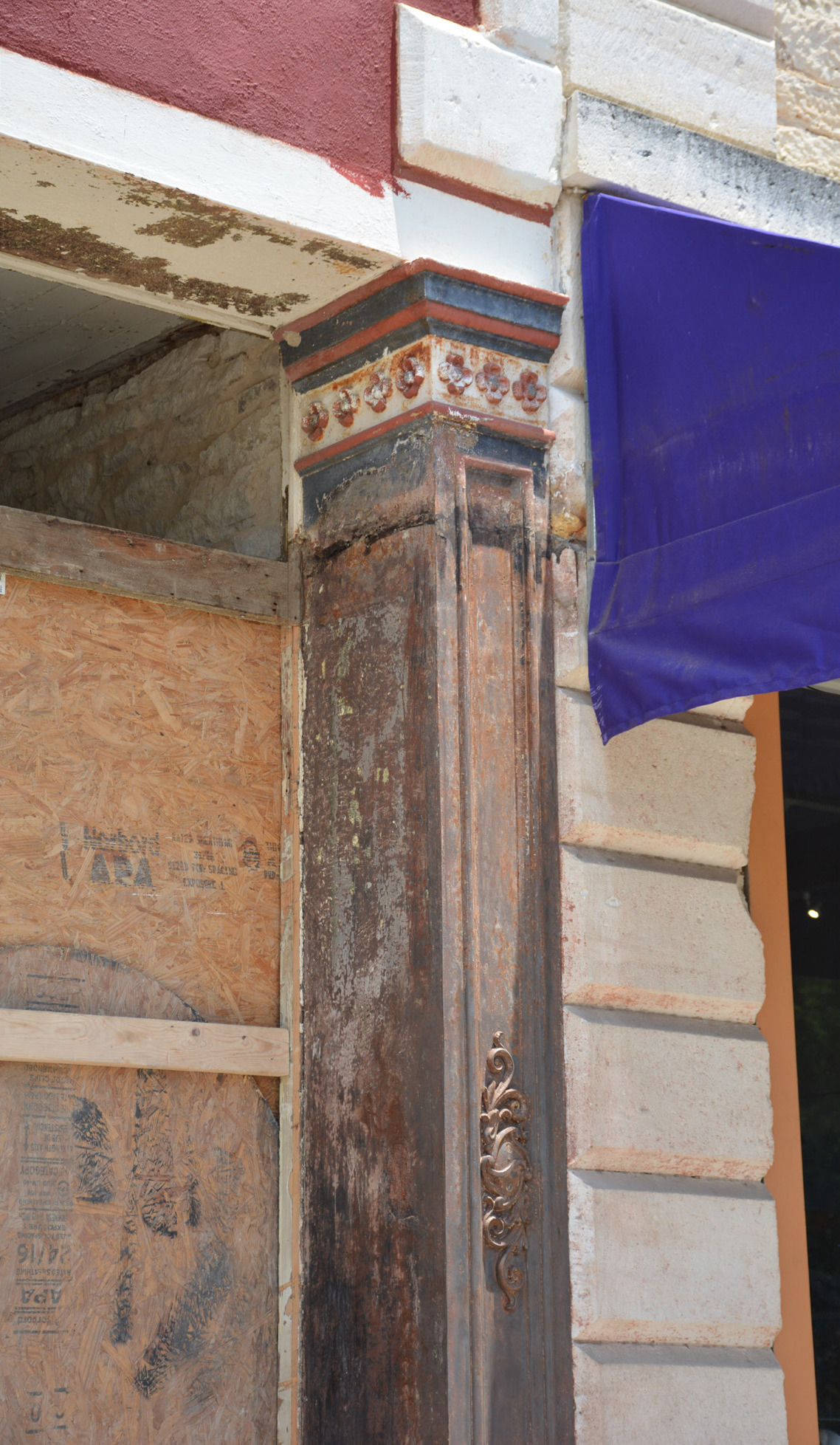

Between the ornate, steel columns of the façade and the thick limestone walls within, one could say the echoes of Lampasas’ ancestors can be heard at 513 E. Third St., a building more than a century old.
Those echoes are now joined by the sounds of construction equipment, as Liberty Hill resident Travis Redding carries out extensive renovations to bring the building back to its heyday era of 1877.
Redding and his wife learned of the property through her real estate business connections.
“One afternoon, she spun the computer around and said, ‘Look at this cool building my friend listed!’” Redding said.
The couple visited the property that weekend, and it was love at first sight. While the couple has experience with real estate development, they knew this building was more than a simple flip project.
“I fell in love with it when I walked in the door,” he said. “I wasn’t looking to flip it. We’re going to put in a distillery bar.”
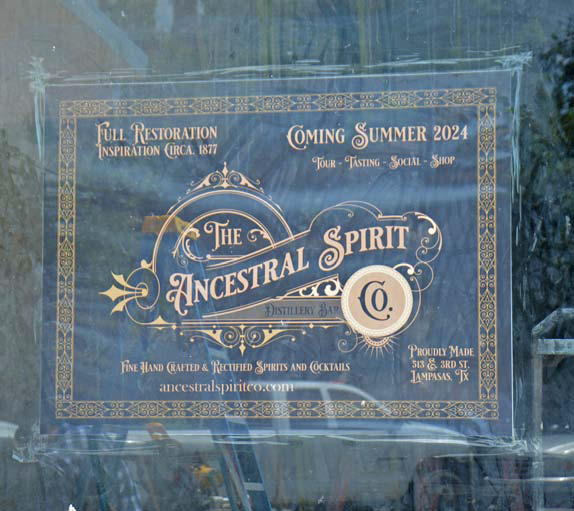
Redding will open The Ancestral Spirit distillery bar at the location when renovations are complete.
PEELING BACK LAYERS OF TIME
Redding said over the course of the renovation, he and his crew have uncovered “four layers of everything – flooring, walls. Over the years they kept patching over everything.”
The first step was an asbestos abatement, which stripped away materials added over the decades.
“Now it’s a matter of stripping it down, going back through time,” Redding said. “My goal is to put it back in original condition.”
For Lampasas Historical Foundation founder Debbie Reynolds, it was music to her ears to learn that someone was interested in the site. After the retirement of Jim and Darlene Rutland from their Rutland’s Fashion & Western Wear store in the spring of 2019, the two buildings that encompassed the business were sold to Rick Hardin. Reynolds purchased the building at 513 E. Third from Hardin and intended to renovate the space herself, but she found herself stretched thin during renovation of The Adelphia, a historic home on FM 580 East.
“I’m thrilled and pleased,” Reynolds said of the purchase by the Reddings. “I was approached by people – they all wanted it for office space. I said, ‘Sorry, but it has to be something that provides vitality to the community.’ … From the standpoint of the Foundation, we’re thrilled someone has chosen to invest in the historical assets of Lampasas – in particular, this building.
“They’re taking it back to its original state and celebrating it,” she said. “Lampasas is fortunate to have people interested in that. These days, it’s so easy just to tear something down. We love it when they go back to something as gorgeous as those columns that have been hidden for years.”
Reynolds and Andy Fish restored both The Adelphia and the Keystone Star Hotel.
“In doing the work we did to the Keystone and The Adelphia, we learned a lot of the time you have to let the building talk to you,” Reynolds said.
Redding said learning about the building through the few photographs that were available drew him deeper into his love affair with Lampasas history.
“The history of Lampasas is epic and incredible,” he said. “I think this is one of the first of four buildings on the square. ... The steel columns we knew were in there. We could see them from above the awnings.”
But the ornate columns had long been concealed by a layer of brick.
“It was a glorious day when we brought that brick down,” Redding said. “I had no idea those columns would have the detail they have.”
Based on Redding’s research, the columns are part of a mail-order kit store front that were commonly used about a hundred years ago.
“I’ve found catalog brochures from the early 1900s to 1920s,” he said.
The next step is to reinforce the second story of the building, which currently rests on the rock exterior walls.
“The upper floor joists are built on top of the stone. They call it building a cage,” he said, adding that the process included the introduction of five-inch steel I-beams and four-by-four steel columns every 10 feet or so to take the weight off the exterior walls.
Redding hopes to have the project completely finished by the end of the year.
“I think I can get the remodel work done for $50,000 to $60,000, but that’s because I’m doing most of the work myself,” he said. “It’s easily a $100,000 project. When I bought it, it was gutted. No plumbing, no electrical. It had gotten to a point where it had to be restored from scratch or turned into a modern building. That wasn’t the route I wanted to go.”
“I think it’s going to be a show piece and stand out on the square,” Reynolds said.
BUSINESS PLANS, PERFECTLY AGED
Redding, who already has a distillery permit in Liberty Hill, plans to open a distillery location at 513 E. Third St. He plans to offer tours of the building in addition to high-quality, smallbatch whiskey.
“The restoration is a part of the business plan – it’s an attraction,” he said. “It puts us on the map.”
Redding added that he literally plans to put the location on the state tour map of distilleries for whiskey connoisseurs and enthusiasts.
Several years ago, state laws regarding the sale of liquors on distillery premises changed, permitting distillers to sell.
“It launched the Texas whiskey scene,” Redding said. “There’s a huge excitement right now in whiskey. … Whiskeys are a few years behind what happened with craft brewing. The best way to make a brand is to tie it to the local history and ingredients.”
In the two years it will take for his first batches of whiskey to age properly, Redding plans to “start off with a rum and a gin,” as well as inhouse beers.
Everything Redding serves will be made on the premises, with the exception of wine, which due to state law can be made elsewhere. He also hopes to offer signature drinks and live music on the second floor.
“It’s beautiful up there,” he said. “When I get a staircase built, I’ll have an open house.”
One of the features Redding treasures is graffiti from a hundred years ago and old paint swatches.
“The very first use of the back of the building was a tin shop,” he said. “They would cut out the stencils and paint it to see what it would look like on the wall. I’m going to do a clear coat of plaster so you can see the graffiti.
“Lampasas history is all up there on the walls.”
RESTORATION EFFORTS TO CONTINUE
Reynolds said she hopes the restoration of 513 E. Third will inspire others to do the same with their historic structures.
“I’ve done tons of research on restoration in small towns,” she said. “It celebrates the history of the town. We hope this will get the ball rolling and get more people on board.”
Redding said this project has impressed upon him the importance of a historical district in towns like Lampasas.
“There’s a whole lot of value to these buildings,” he said. “I wish I had more funds. I’d start buying more!”
A historical district could offer protection to aging structures in need of care and reconstruction, Redding said.
“That would allow us to make sure we could prevent someone from knocking them all down,” he said.
When he went to Lampasas City Hall to receive a demolition permit for the removal of drywall, he gave the city staff member an unintentional scare.
“I told her I needed the permit for this address, and she looked at me and said, ‘You’re going to knock it down?’ I said, ‘No, no, for drywall!’ But I could have, and that’s a scary thought to me,” he said.