

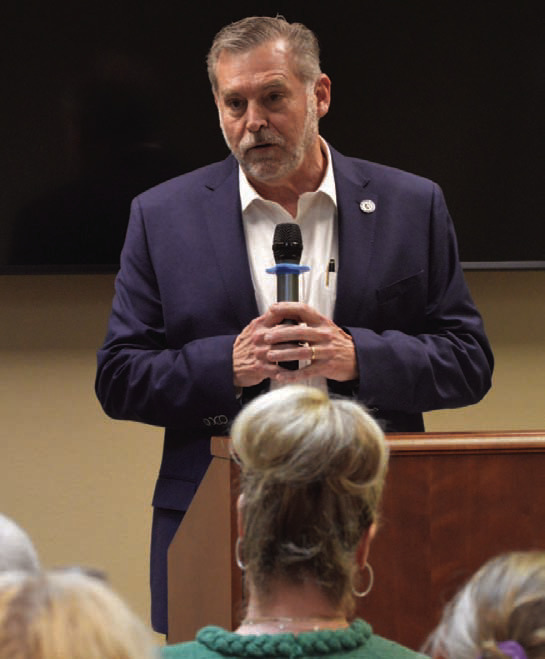
Data centers and proposed 765-kilovolt transmission lines are the top concerns for Lampasas County residents and constituents in the 12 rural counties State Rep. David Spiller (R-Jacksboro) serves.
Last week, Spiller sat down with Brad Johnson of the Texas Bullpen Podcast to discuss both issues that are deeply impacting his district.
Spiller is one of 43 state lawmakers who has signed off on an amicus brief to delay decisions on proposed 765-kV lines. This includes the 200mile Bell County East to Big Hill transmission line that would pass through Lampasas, San Saba and Mills counties.
Another project, the Dinosaur to Longshore 765-kV line, would pass through Comanche, Brown, Eastland and Shackelford counties in the northern part of Spiller’s district. The lawmaker believes there are many questions still unanswered on the purpose of these lines.
“Why are we transporting power to West Texas? They have their own power,” Spiller said in his recent sitdown podcast interview. “I have yet to have anybody explain to me why this is necessary. I think those are some of the concerns that continue to be raised by not just myself but other representatives and senators.”
Only data centers rank higher on the minds of Spiller’s constituents than the 765-kV lines. According to DataCenterMap.com, there are 505 such facilities developed or in motion in the Lone Star State. However, none of those are located in Lampasas County.
Nonetheless, Lampasas residents have been outspoken against the possibility of data centers, citing concerns over energy and water usage. Spiller believes more “guardrails” need to be in place to ensure data center development is responsible.
“Water is a huge issue,” Spiller said. “What is sometimes not discussed is they say, ‘Well, data centers are using a closed-loop system.’ OK, well that is good. Number one, they are not really required to, but they should be. The other problem is that they have power generation for the data centers. Well, those power generators are not using closed-loop systems. That is where the water use comes in.”
Of the 12 counties Spiller represents, five have an underground water conservation district. In Lampasas County, the Saratoga Underground Water Conservation District has the authority to ensure a commercial company, like a data center, meets the desired future conditions for the underground water supply. If the development doesn’t, the district can deny a well permit.
The Saratoga UWCD Board of Directors has petitioned the county for more funds to operate as the state requires and to have a better understanding of its desired future condition. Without an underground water conservation district, regulating data centers is difficult for a county.
“If these counties don’t have that protection in place, it is the Wild West under the rule of capture,” Spiller said. “Somebody can come, a commercial person, can come right up next to your property, drill wells, suck your residential wells dry, and there is not a darn thing you can do about it.”
Currently, county governments have no ability to deny a data center. In May, Hill County approved a one-year pause on data centers, but later rescinded the moratorium after a lawsuit from a developer was filed.
Spiller told the Texas Bullpen Podcast that lawmakers could entertain giving counties more authority.
“There is very little that the county governments have the authority to regulate,” he said. “It may be time for a discussion at least. I’m hearing from a lot of my counties. The dilemma, they say, ‘Well, OK, the only way we can have any control is if we do a tax abatement agreement with them and a pilot program.’” As talks about 765-kV lines and data centers continue, Lampasas residents and their neighbors will be watching closely to see how Spiller and other lawmakers react when the legislative session begins in 2027.
