

The Lampasas County Commissioners Court has committed to drafting a resolution opposing data centers and renewable energy projects like battery energy storage systems (BESS) in the county.
The decision came after residents expressed concerns in Monday’s regular meeting. Although there are no plans yet for data centers in Lampasas County, 10 active BESS or solar projects are underway, according to the Electric Reliability Council of Texas’ most recent GIS report.
At the court’s Feb. 23 meeting, Lometa-area residents Ted and Sharon Newsom alerted commissioners about the 200 MW Thomas Cameron BESS facility on County Road 2275 that is under development and expected to be completed in May 2027.
For the most part, commissioners were unaware of renewable energy projects slated for Lampasas County. During Monday’s meeting, County Judge Randy Hoyer said the county does not need to be made aware of developments.
“This all goes back to private property rights,” Hoyer said. “If a green energy company desires to come into the county and put in a BESS [Battery Energy Storage System] or a wind turbine or a solar farm or even a data center, and they negotiate with the landowner and are not coming to us with an abatement [request], we may not even know about it.”
Multiple Hill Country counties, including Gillespie and Kerr, have taken action to regulate BESS facilities by adopting fire codes.
Currently, Lampasas County does not have its own fire code.
Hoyer noted other counties have passed resolutions against BESS facilities and data centers, a route Lampasas could pursue in the future.
“Realistically, statutorily, we don’t have any regulatory authority to stop or prevent it,” Hoyer said. “But [a resolution] is still something we can do to show that we support the residents of the community.”
COMMUNITY FEEDBACK
Area resident Mickey Edwards expressed concern about data centers potentially coming to the county. The rancher said the county does not have the energy infrastructure or water supply needed to support such a facility.
“Quality of life is very important in our county; it is a good place to live,” Edwards said. “If we start seeing a lot of this kind of development, it may not be as good of a place to live. It increases the electric cost by about 10% in most communities.
“A large data center would take the same amount of power as 100,000 homes,” he said. “Think about those things.”
Edwards told commissioners he was against the county granting an abatement of any kind.
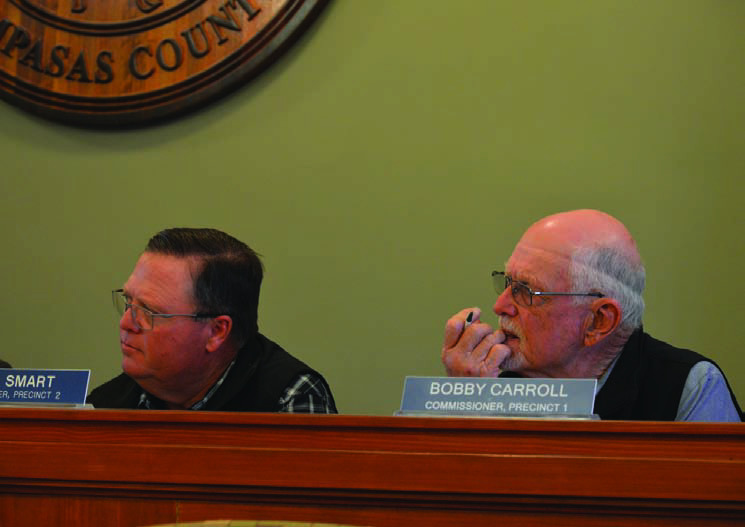
Precinct 1 Commissioner Bobby Carroll and Precinct 4 Commissioner Mark Rainwater also said they are not in support of granting developers tax incentives.
Rainwater labeled renewable energy projects and data centers a “double-edged sword,” noting the potential tax revenue such facilities could bring.
“You have a benefit from some of the things tax-wise,” Rainwater said. “It would make everyone’s taxes go down. On the other hand, we don’t want them, and I don’t. You have to pay more to live here without those things, and I think people are willing to do that.”
While not necessarily in support of abatements, Hoyer said they do give the county more regulatory authority over a development.
“You have the grounds to negotiate to put in a sound barrier wall, to require them to put in landscaping to make it look perhaps a little bit better,” the county judge said. “Road use agreements so that if they tear out the road, they have to pay, and decommissioning bonds so that at the end of the life or the company goes bankrupt, there is a bond sitting there to remove the facility.”
County resident David Barclay voiced his concerns with BESS facilities. Barclay told the court he worked 37 years with Chubb Insurance and was involved in its energy operations and insured everything from nuclear power plants to offshore platforms.
Barclay said he could never “wrap his head around” BESS facilities due to their fire concerns.
“If you have a fire, it is not easy to put out,” he told the court. “I’m concerned when we talk about abatements. I might flip that around and say we need more fire protection.
“I just caution us because they are scary fires for people -- the firemen, for everyone,” Barclay said. “That has to be taken into consideration.”
Carroll said he sympathized with Barclay’s concerns. Carroll said he has family members who live in Mason where a BESS facility is located, and they have been notified that anyone within two miles of the facility would need to evacuate in case of a fire.
“That would be a pretty scary thing,” the commissioner said.
Commissioners were asked why they can’t ensure data centers or BESS facility developers are required to present their projects to the court.
Hoyer said although the state grants the county authority on subdivisions, it doesn’t have the same powers when it comes to renewable energy projects or data centers.
Lampasas lawyer Jo Ann San Miguel said commissioners could be doing more to slow the growth of data centers.
“I have been following county judges across Texas who are doing something about these data centers, who are putting moratoriums, filing lawsuits, who are making contract decisions and issues,” she said. “There is absolutely something that can be done, and I would appreciate that there is more research and involvement in looking into these avenues.”
San Miguel noted Hays County Judge Ruben Becerra has voiced his intention to seek a moratorium on large-scale developments requiring a healthy supply of water.
Precinct 2 Commissioner Jamie Smart said Lampasas County does not have the same type of funds as Hays County, but he recommended local officials seek legal advice on how Lampasas County might regulate such facilities.
Carroll said the best way Lampasas County can prevent data centers or renewable projects from moving here is by not giving developers the opportunity.
“I think the number-one thing we can do is talk to all of our friends, neighbors and citizens of Lampasas County,” the commissioner said. “If they don’t sell land or lease it to them, we won’t have them.”
Hoyer ended the 30-minute discussion with a plan of action after hearing the concerns of county residents.
“The Commissioners Court has a clear direction based on the dialogue we received and how we are going to proceed,” Hoyer said. “We will follow up at some future meetings, so kind of be listening and looking. I appreciate all the input from everybody.”
