



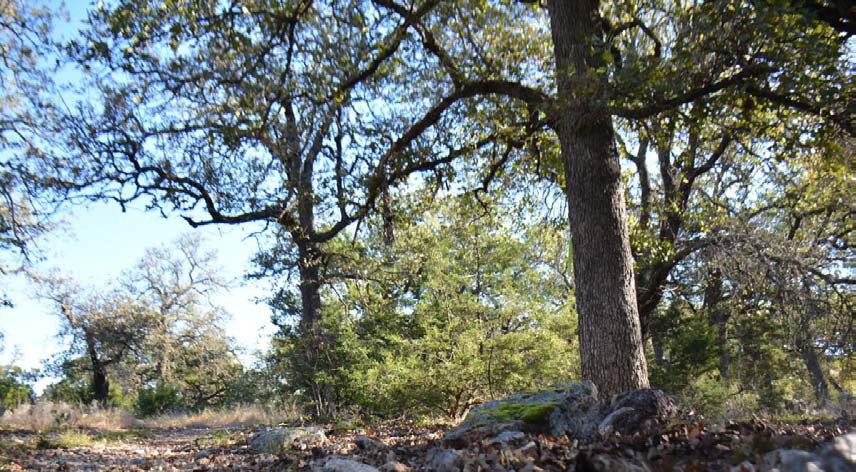
Post Oak Ridge State Park, about 15 miles from the Lampasas city limits, hopes to have day passes available by the fall of 2026. Drawn public hunts already have been held there, and the park will host a guided hike on Jan. 1, 2026, although registration for the event already reached capacity.
The 3,118-acre park is located northwest of Naruna at 4136 CR 105 in Burnet County, but part of it extends into Lampasas County.
John Fletcher and Mattie Lou Vann settled this rugged stretch of land near the Colorado River in 1889, making a home for seven children and their descendants. Over the years, Vann family members ranched, chopped cedar and opened a popular fish camp on this land, the Texas Parks and Wildlife Department website explains.
TPWD purchased two tracts of land from the descendants of the Vanns in early 2025.
Although development of a state park sometimes takes about 10 years, Park Superintendent Kacey Sloan said this is a fasttracked project. It is funded by the Centennial Fund, a state conservation fund created after Texas voters approved it by constitutional amendment in 2023. That year was the 100-year anniversary of the creation of the State Parks Boards.
“It’s going to be great for trails,” Sloan said. The skies are “very clear out here … You can stand out here and hear no mechanical sounds, not hear any man-made sounds.”
Sloan was hired as park superintendent on Aug. 1, and one maintenance worker joined the staff Nov. 3.
“Right now there’s just two of us,” Sloan said.
Although the two staff are on site regularly during the week and sometimes on weekends, the park is not open regularly yet for public use.
Phase I of the park’s development, the initial 12 months since closing on the property last winter, focuses on preparing it for public use such as in drawn hunts and guided hikes or tours. Phase II aims to have the park ready for day use with essential facilities in place such as trails, parking areas and restrooms, within 18 months of the property purchase. The goal of Phase III is that within 48 months of purchase, the park will be open with roads, utilities, communications and facilities.
Maintenance work during Phase I often involves repairing pasture roads, which will become future hiking trails, after heavy rains. Much of Sloan’s work also involves familiarizing herself with the land, developing emergency plans and handling inquiries from the public.
During the past several months, surveys have been conducted to determine any areas of archaeological or historical significance as well as tree surveys. TPWD aims to keep as many live mature trees as possible.
The area’s first public hike will be a 5-mile jaunt – out and back, 2.5 miles each way – to the Post Oak Ridge, a geographic feature that gave its name to the state park. Parking is limited to 10 vehicles until a more permanent parking lot is put in, and the event was booked by earlier this month.
TPWD hopes to develop 20 miles of hiking trails. At least one of the more level areas of the park has been identified as a prime location for a wheelchair-accessible path.
Those who have surveyed the property “think some of these trees might be 400 years old,” Sloan said. As for the results of archaeological studies, “This was more of a transition area, not a long-term encampment,” she said.
Historical surveys also factor into decisions TPWD is weighing, such as whether an existing house near the property’s entrance would be a suitable park headquarters.
In addition to post oaks, the land features numerous live oaks, cedar, persimmons and sycamores
One of the most striking views from Post Oak Ridge State Park are these towering cliffs on a private ranch, directly across the Colorado River, which forms the western boundary of the park.
near the bodies of water on the property.
Sloan mentioned that this year “acorn production was really high, as well as persimmon,” and both are important food sources for deer.
“There’s a lot of mountain laurel, which has a really pretty purple flower,” she added.
The park superintendent said she expects the park to be fully developed within four years. That will involve significant infrastructure work, but TPWD always tries to maintain much of the existing habitat and natural resources of its land.
In developing a state park, “You’re building a little city,” Sloan said.
Now, during Phase I, Post Oak Ridge does not offer potable water, but there is a vault toilet. RV host sites are in the plans further down the line.
A ’COMPLEMENT’ TO COLORADO BEND
TPWD also plans to see Burnet County Road 105 widened, and officials are debating whether or not to have an official crossing point between Post Oak Ridge State Park and Colorado Bend.
TPWD purchased part of what is now Colorado Bend State Park in 1984, and the rest in 1987. It comprises 5,328.3 acres on what was formerly the Gorman ranch and Lemons ranch in San Saba County. It features 35 miles of hike-and-bike trails.
When the river is low, there are spots where pedestrians easily could walk across from Post Oak Ridge.
State parks typically would require separate entry to get into each park. In cases of emergency evacuations, missing hikers and personnel accountability though, Sloan said, it would be beneficial for the two parks to have some coordination to keep track of who is where. An official crossing point could make it easier to monitor when visitors leave one park and enter the other.
Radio is the main method of communicating within Post Oak Ridge State Park. Cell phone service and internet are limited, with a signal available at some of the high points.
“Every day is different. I do not have a standard workweek,” Sloan said. “Some days I spend the whole day driving to spots to check radio signals.”
The area of the Colorado River north of Lake Buchanan is known for world-class bass fishing in the late winter and early spring. Post Oak Ridge State Park currently has one primary area for accessing the river, near the historic fish camp. It includes a roughly 100-yard grassy area near the riverbank, and it faces a towering cliff across the river on private property that has a waterfall in wet periods.
Overall, the steep rocky terrain makes it difficult to reach the river by foot or by vehicle, which Sloan said is one of the major challenges in developing the park. Last summer’s flooding did not cause significant damage to the land or structures there, she added.
From Post Oak Ridge State Park, the head of Lake Buchanan is about 10 miles south, and Buchanan Dam is about 20 miles south. As the Colorado River is a navigable waterway, boaters can travel upstream to view the park and fish in the public waters of the river in between the park and neighboring private property.
TWPD accepts applications each year for hunts on public land throughout the state. This past November, 12 youth hunters took to the blinds at Post Oak Ridge State Park, and altogether they were able to harvest 10 white-tailed deer.
Other wildlife seen there include turkey, quail, aoudad, hogs and “lots of roadrunners,” Sloan said.
Snakes “are part of the natural habitat, so they stay, unless there’s a situation where they’re a safety issue,” she added.
Even cedars, which many ranchers are eager to eradicate on their property, are valued by TPWD for their contribution to the golden cheek warbler’s survival. Warblers strip bark off mature cedar trees for nest material, although they often nest in oaks.
GROWING POPULATION CRAVES OUTDOOR GETAWAYS Sloan’s ranching heritage and work experience make her a prime fit to oversee the new state park. She grew up in San Saba County and is related to the settlers who founded the community of Sloan.
“I grew up on the Sloan Ranch, lived on Sloan Road, went to Sloan Church,” she said.
Park superintendent is a position she applied for, rather than an appointed position. Although she grew up on a ranch, Sloan understands that not everyone has the same access to outdoor recreation. And she worked her way up through TPWD ranks the same way many others would.
She started as a volunteer, helping clean up parks and assisting with hikes. She worked at Pedernales Falls and later at Inks Lake before becoming superintendent at Post Oak Ridge. She is entering her fifth year with TPWD, and she also is a kayak instructor.
Her experience at those other Hill Country parks confirms what TPWD knows: As Texas’ population grows, so does the demand for outdoor recreation.
“Both parks I worked at, every weekend we turned people away,” Sloan said.
The demand for hiking, fishing and hunting opportunities outpaces the supply, particularly in Central Texas, which has seen some of the state’s most aggressive growth in recent decades.
Colorado Bend, for example, averaged more than 84,000 visitors from 2020-2024, according to KXAN news. It was not even among the top 10 mostvisited state parks in Texas.
Although Naruna remains an unincorporated town, it has seen significant development in the past five years as ranchland has been subdivided.
Post Oak Ridge State Park will be a few miles closer to the city of Lampasas, where three major highways converge, than Colorado Bend State Park is. So there is potential for large numbers of visitors once the park opens and word spreads.
“The idea is to make it a complement to Colorado Bend,” rather than a competitor, Sloan said.
TPWD invites the public to attend a meeting Jan. 15 from 6-8 p.m. at the Lampasas County Annex at 409 S. Pecan St. to participate in the park’s planning process. The event will feature interactive stations and a chance to speak with members of the planning team.