

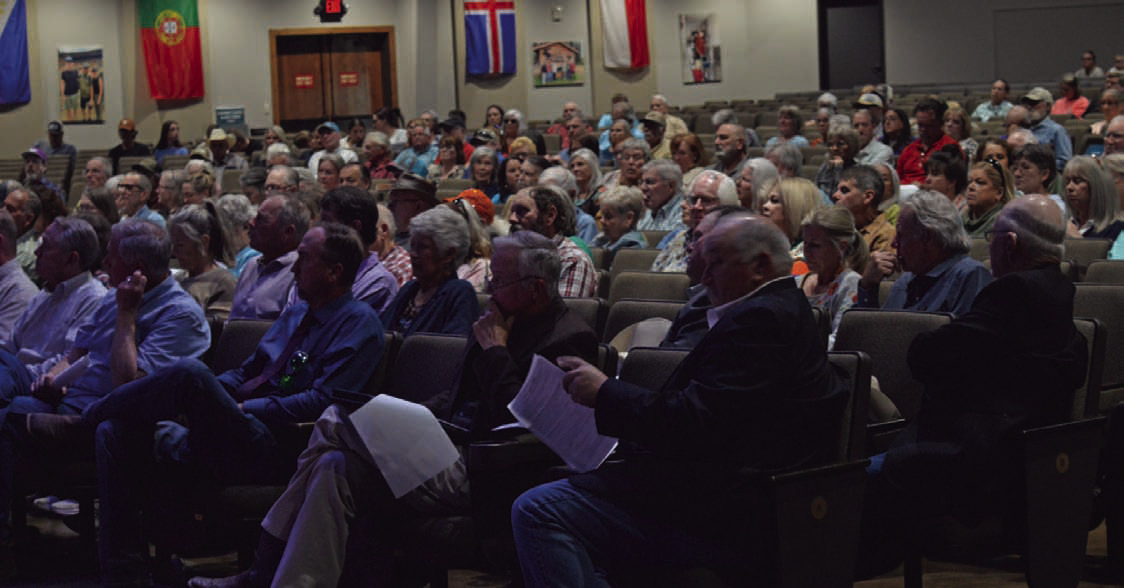
Several hundred Lampasas County and Burnet County residents filled the Hill Country Fellowship sanctuary on Tuesday to hear updates and voice concerns about the proposed 26.9-mile rail line Texas Materials Inc. would like to construct.
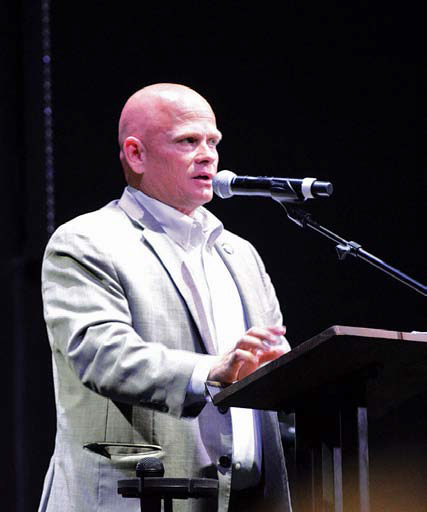
The session held jointly by the Commissioners Court of the two counties was led by Burnet County Precinct 2 Commissioner Damon Beierle, who provided those in attendance with an outline of the next steps in the project.
A letter from the Surface Transportation Board’s Office of Environmental Analysis was sent in early March to commissioners in both Burnet and Lampasas counties, as well as to other elected officials and to tribal nations, notifying these entities of the proposed rail line from Texas Materials.
The line, as proposed in the letter, includes reconstruction of 12.5 miles of line on the right of way of a former railway plus 14.4 miles of new rail line. Texas Materials would haul aggregate from four Burnet County-based quarries to eastern Lampasas County over this railway.
Beierle emphasized that the letter doesn’t mean Texas Materials has filed the project officially yet. The commissioner said the proposal is still preliminary and in the review process.
“Texas Materials hasn’t even filed anything yet,” Beierle said. “So, what happened is they went to the Surface Transportation Board and sent them the routes you guys have seen, the proposed routes and the existing right of way, and they put it up there. It’s not filed yet.”
Beierle told the audience the April 14 comment deadline mentioned in the March 14 letter is not for affected landowners but for government officials and tribal leaders.
The next step after the comment deadline will be an on-site visit from the STB.
“The Surface Transportation Board is going to do an on-site visit and do an initial overview of the map and proposal that Texas Materials sent them,” Beierle said. “That is between them and Texas Materials. They are going to go and only view areas from public view. They are going to go down county roads and things like that.”
Beierle said he asked the STB if commissioners could be a part of the initial visit. A visit with public officials and landowners will occur after the STB decides between two options, he said: an environmental impact statement with a two-year assessment with two public comment periods, or an environmental assessment with a one-year study and one public comment period.
Beierle expects the first public comment period to begin in 30 to 45 days, likely in the summer. He said citizens will be made aware when that period opens.
After the STB decides on a one- or twoyear study, it will make a second on-site visit with some fieldwork and landowner input. Beierle said he has requested to be part of that visit and is looking for interested landowners who want to be on the STB’s schedule of stops.
“In my mind, if we can get them on those properties to see it rather than just read it, that is going to have much more impact in their review process and in the statements they make and recommendations they make to their board that ultimately decide,” Beierle said.
The commissioner said the STB’s review will consist of four criteria, with numberone being “transportation merits” – a focus on the necessity and public benefit of the proposed line. The other three criteria include historical, environmental and archaeological studies.
Beierle told audience members the Texas Historical Commission has sent a letter asking the STB for a thorough review. District 24 State Sen. Pete Flores (R-Pleasanton) and State Reps. David Spiller (R-Jacksboro) and Ellen Troxclair (R-Lakeway) also have submitted letters signaling their concern, he said.
On Tuesday, the Burnet County Commissioners Court passed a resolution stating its opposition to the project. The Lampasas County Commissioners Court is expected to follow suit in its regular meeting on Monday.
PUBLIC COMMENTS
As in previous public meetings, numerous voiced their concerns regarding the rail project. One area resident asked how a private company like Texas Materials could use eminent domain to acquire private land.
Dennis Donley, an eminent domain lawyer, was in attendance at the Burnet meeting. He said a railroad can pursue eminent domain because it is a common carrier. He also provided landowners a tip if eminent domain proceedings were to occur.
“Most of these easements haven’t been utilized since the ’50s. Adverse possession in Texas is 10 years,” Donley said. “As an example, on my family’s property which is on County Road 201, we’ve had this piece fenced in for our use since the ’50s. So, for 70 years a railroad person hasn’t stepped across the fence; for 70 years they haven’t accessed our property.
“I suspect that is true for some of you as well,” the attorney continued. “So, you need to get those facts together and get something filed with the county that says, ‘No, this is my property.’ That is not going to stop them from coming, but it means if they do come, you guys can get a little money if they do.”
Another landowner asked Donley if class-action lawsuits could slow down the project.
If that were the case, Donley said he already would have done that. He encouraged residents to support Troxclair’s legislation that aims to slow the demand on rock quarries.
House Bill 3482 would restrict the Lower Colorado River Authority from issuing permits for new mining operations unless a study confirms no natural harm is done.
Also during the public input period, Gilbert Riojas – who owns property in both Lampasas and Burnet counties – asked Beierle about the tone of Texas Materials in his discussions with the company. Beierle said the CRH Americas Materials subsidiary was by no means arrogant.
“I felt like they weren’t as confident as I thought they would be, that they do realize this is process that has a lot of variables and a lot of input and a lot of impacts,” the county commissioner said. “I didn’t take the fact they were just super-confident in all this.”
In his talks with Texas Materials, Beierle said the company made it clear it would not seek eminent domain proceedings before consulting landowners.
“They did say if this gets approved, they will go to each landowner and negotiate before eminent domain,” Beierle said.
Although the comment period is not aimed at residents’ input, environmental concerns regarding the project can be filed by April 14 by visiting STB’s website at stb. gov and clicking the “File an Environmental Comment” tab.
