

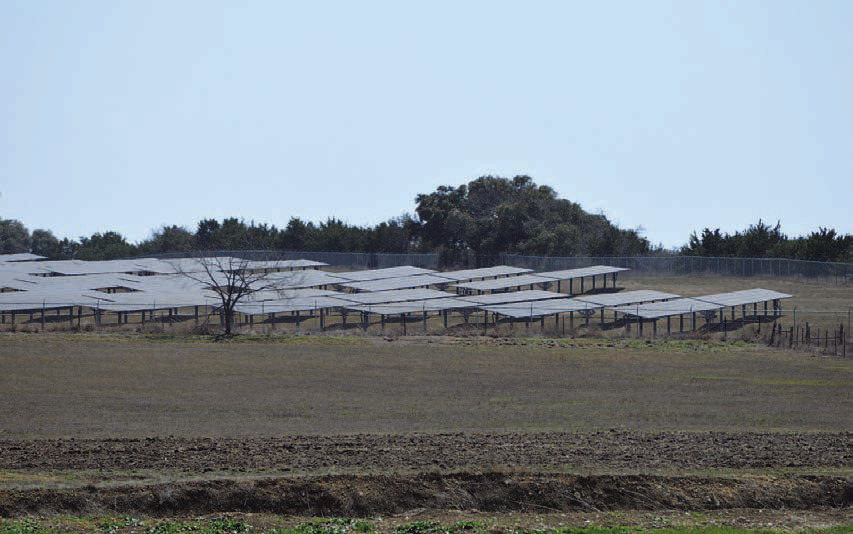
The Lampasas County Commissioners Court adopted changes to its tax abatement guidelines on Monday after several battery storage and solar companies expressed interest in coming here.
County Judge Randy Hoyer said there has been contact made regarding the two potential Precinct 1 projects.
“They have not officially asked yet to discuss an abatement, but I anticipate that they might,” Hoyer said.
Before action was taken during Monday’s meeting, a public hearing was held on the decision to participate in the tax abatement and the adoption of new guidelines.
An abatement under Chapter 312 of the Texas Tax Code allows commissioners courts to exempt part or all of the increase in property value for a business for up to 10 years.
Commissioners also may grant a Payment in Lieu of Taxes. PILOT is a negotiated payment made by the property owner to a commissioners court to compensate for lost tax revenue while supporting local services.
Hoyer noted the court’s authority is limited to granting an abatement or PILOT to an entity.
“These solar farms, battery storage and wind is between the company and the landowner,” Hoyer said. “The only way the county gets involved is if there is a request for an abatement of some sort. Abatements are really not that popular anymore. It’s a PILOT -- a payment in lieu of a tax which can be negotiated through our tax abatement policy.”
To engage with a company over a tax abatement or PILOT, commissioners must have an established policy. Commissioners achieved that in 2022, when renewable energy company Green-Go approached county officials over a proposed solar farm.
An update to the tax abatement policy was needed to comply with state law changes.
Steve Cook was the lone Lampasas County resident to speak during Monday’s public hearing.
Although he said he supported the court’s abatement guidelines, Cook cited concerns with the inequality of giving some businesses tax incentives. He also voiced problems with ranch and farm land being used for renewable energy projects.
“If you really cared about generating power and saving stuff, all these roofs you’d put these panels on,” Cook said. “The school would probably make millions over the summer with solar panels on them versus farmland. In Bell County toward Heidenheimer, the black soil, that is farmland. Some of the most fertile land in America is now solar panels to power AI facilities and stuff like that.”
Commissioners were not shy about stating their thoughts on tax abatements. Precinct 2 Commissioner Jamie Smart said the county may have missed an opportunity at increased revenue with the proposed solar farm by Green-Go in 2022 that commissioners voted down after a vocal outcry from the public.
“People say, ‘Oh, we are giving away tax money,’ as in the solar farm,” Smart said. “I think I said this back then. That particular ranch brought in $7,000 a year in revenue to the county, and over a 12-year period of time that is $84,000, and they [Green-GO] were proposing over that same period of time we would have received around $14 million worth of revenue.”
Smart said the need for power is obvious to accommodate growth approaching Lampasas County from Killeen and Austin. Although not a proponent of wind or solar energy, Smart said he doesn’t want the county to be left behind.
“We are going to find ourselves in an island where we are not doing anything to help support this, and in turn is that going to make it where they say, ‘You didn’t do anything to support it, so that power is not here.’ I don’t know,” Smart said.
Precinct 4 Commissioner Mark Rainwater expressed his distaste for tax incentives.
“I’ll be plain forward, I will not vote for a tax abatement today, tomorrow or the rest of my term,” Rainwater said. “I think if you are able to go into business and it makes sense to go into business, you need to pay the piper. Nobody ever gave me a tax abatement, and I’ve been in business a long time. Some of y’all have too.”
Precinct 1 Commissioner Bobby Carroll agreed with Rainwater’s sentiment but said the court needs an open mind when discussing an abatement with a potential suitor.
“I do feel we need to look at everything at an individual basis when it comes in,” Carroll said. “Mark [Rainwater] and I think a lot alike, but there could be something that changes my mind.”
Commissioners OK’d a resolution to participate in the tax abatement process and to adopt the new tax abatement guidelines. The vote carried 4-1, with Rainwater the sole dissenter.
