

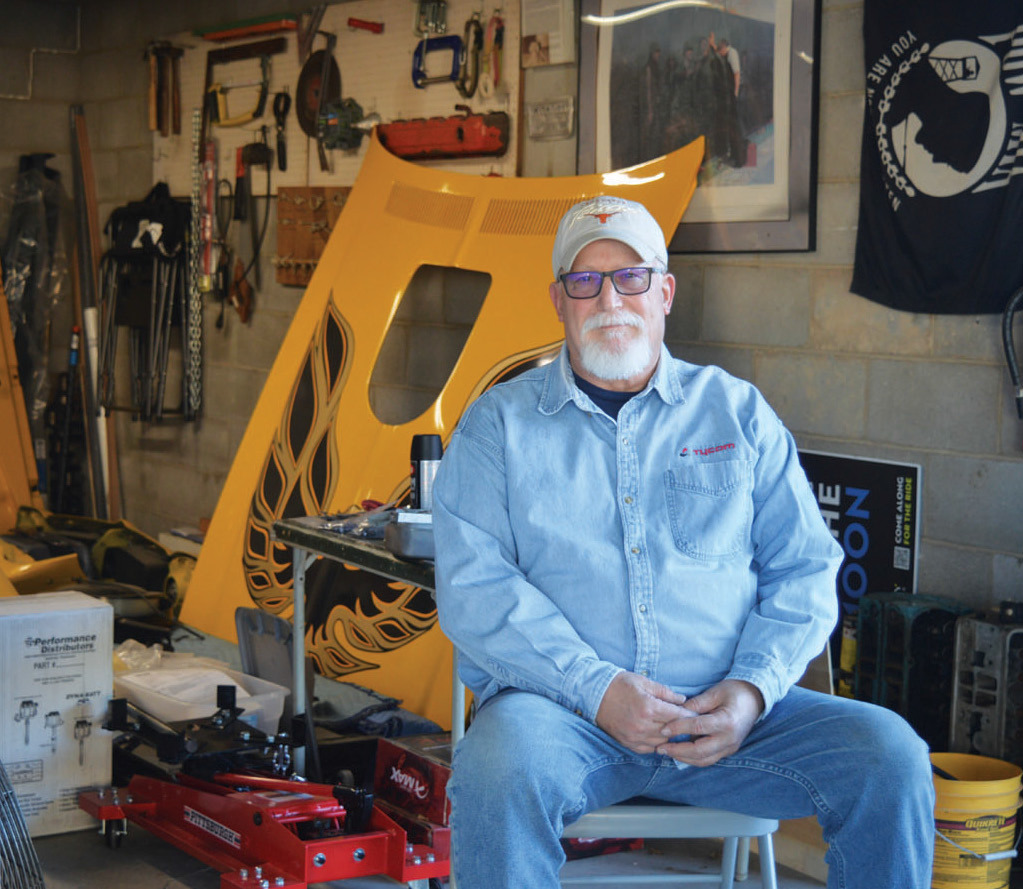
Lampasas resident Howard Tucker is keeping the spirit of Pontiac alive today.
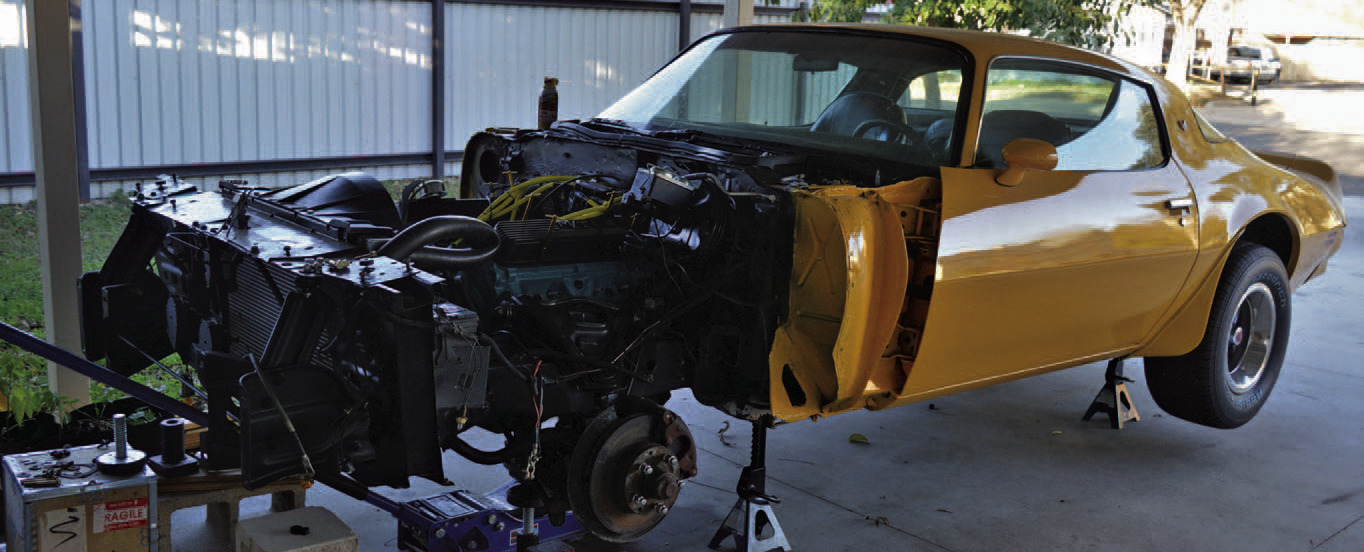
After nearly 50 years of restoring automobiles, more than half of Tucker’s 250 projects have been various models of the Pontiac Trans Am. Currently, Tucker is working to restore a 1976 model. Since he was a child, Tucker has been captivated by cars.
“I think I was born that way,” he said of his love for automobiles. “I just remember early on having an interest in them. I’m a military brat, so I remember living overseas in Japan and seeing what they call a [Pontiac] GTO, and I was bent on getting one of those as my first car – which I did.”
A member of the Lampasas High School Class of 1974, Tucker credits the Lampasas community for giving him the knowledge he needed to make car restoration a hobby.
“When I moved here back in the early ’70s, I ran into a bunch of what I call legends. They are still around here today,” Tucker said. “They are probably 10 years older than I am and still doing it even today, but they taught me a lot and made me better at what I do.”
Tucker has a degree in engineering, which he obtained from The University of Texas. During his time working at IBM in the Austin area, Tucker said he often spent free time scavenging for vehicles to bring back to life. He had so many cars in and out of his lot, it brought false assumptions from neighbors.
“I would bring these cars home and strip them down, and my neighbors would accuse me of stealing cars,” Tucker said. “It happened twice, and the police would come over and check the VINs because I would drive these cars home and strip them for parts.”
CURRENT PROJECT
Typically, Tucker restores low-production cars, meaning there are few in existence. In the 10-year span the Trans Am was made, he said only around 500,000 were crafted. However, the 1976 model Tucker is working on is even more unique because of its 455-cubicinch (7.5L) V8 engine.
“Only 7,000 were made in 1976 with that motor,” Tucker said. “That is what attracted me to the car and, to me, what makes it worthy of putting in the restoration level of what I’m putting into it. It will basically be a brand-new car when I’m done with it -- every bolt, every thing.”
Tucker received this 1976 Trans Am several years ago but said his day job inspecting rocket engines at Firefly and other responsibilities get in the way of the hobby. In his younger years, Tucker said he could restore up to three vehicles in a year.
It also takes time to find parts. Although the 1976 Trans Am Tucker is restoring was in good condition when he obtained it, much of what made the vehicle special had disappeared.
“The mechanical part is original, but the person I got the car from put a lot of aftermarket parts on that car, like the carburetor, suspension, all these parts you add on to the car,” he said. “All of that had to be removed and replaced.”
While the internet is an option for finding parts, decades of restoring Pontiac cars has opened Tucker to a network of Pontiac connoisseurs like himself. A member of multiple Pontiac national clubs, Tucker has shown cars at the Trans Am Nationals in Dayton, Ohio. Those automobile expeditions have expanded his network in the Pontiac world.
“Through those travels, I meet a lot of people, and I can usually call them, and they will either have it or know where one is at,” Tucker said. “Everything is about numbers. I’m only going to buy something during the timeframe that the car was built. If that car was built in August of 1976, I’m only going to find parts made in August.”
Unlike other car manufacturers, Pontiac has a special place in Tucker’s heart because of the ability to plug-and-play with its parts.
“The thing with these guys, they were racecar people from the very beginning. They were a very competitive bunch of people,” he said. “They designed Pontiac where you could interchange parts. Chevrolet, Ford – you can’t do that. The only way you can make a Chevrolet or Ford go faster is to buy aftermarket parts.”
For the motor on his 1976 Trans Am project, Tucker installed a 1970 camshaft, a 1970-cylinder head and 1970 exhaust manifolds to increase horsepower.
“When that car rolled off the assembly line, brand new in 1976, it only had 200 horsepower,” he said. “I can show tickets that the motor is producing over 450 horsepower right now, based on those components.”
Tucker feels he is in the final stages of this Trans Am project.
“I think I am now getting to the point that everything I want to do to the car has been done. It is just a matter of putting it back together,” he said.
Tucker acknowledges the paint color on this project is different than what would have driven off the lot in 1976, with the Pontiac savant opting for a modern yellow. Nonetheless, the Trans Am lettering on the back remains true to its origin.
“The original painting and lettering, they [GM] sold it off to a graphic company so they can reproduce and use the same prints and material that they used,” Tucker said. “What you see on it is identical to what was produced back then.”
MAKING A HOBBY A SMALL BUSINESS Tucker has purchased patents of his own to bring the true thunder of the Trans Am back to life. He is the sole producer of a performance kit that makes the iconic shaker hoods of the vehicle functional. The shaker hood, also called an induction system, was developed by the late John DeLorean for the Trans Am.
“It’s a flap that stays closed until you hit really hard on your accelerator,” Tucker said. “Then it opens up and allows the cold outside air to come into your carburetor. Well, every degree of temperature drop from your intake into your carburetor equates to horsepower. To me, it was a sin to take it off the car because it was part of the power.”
The shaker hood was a key feature on the Trans Am, but it became purely a visual accessory when it was outlawed by the government in 1972 due to noise concerns. Trans Ams manufactured from 1973 did not contain a functional shaker hood.
“In 1977, I bought a brand-new Trans Am here in Lampasas,” Tucker said. “The first thing I did, I cut that scoop open because that is how it was designed. I knew about this because I earlier had a 1970 Trans Am, so I knew how it all worked. At that time, I decided to manufacture my own kits so I could sell to the Trans Am community.”
Since he launched his side business in 2000, Tucker has sold over 13,000 shaker kits. While the side gig brings in extra income, for Tucker it is all about his fervor for the Pontiac.
“It has never been about making money to me,” he said. “I always kept it very cheap, affordable, and by doing that nobody else has tried to go into that because most people try to make money off that deal. That has never been my thing. It is just a passion I have for these old cars.”
Through his restorations and shaker hood kits, Tucker can ensure the roar of Pontiac’s golden era echoes on.