

WRA Architects presented three options for a new middle school campus to the Lampasas ISD Board of Trustees on Monday.
All three options were based off utilizing the current Lampasas Middle School property.
WRA Architects representatives Justin Bell and Josh Burkhart discussed the potential layout, master planning, phasing and parent/bus pick-up and dropoff points of each option.
Lampasas ISD is preparing for a potential 2026 bond election. The district’s Facilities Planning Committee, which is in charge of formulating ideas for what the bond would encompass, has held two meetings so far. A third meeting is set for later this month to discuss the costs of possible projects that include a new middle school, a fine arts facility/auditorium, transportation upgrades and security improvements at each of the district’s five campuses.
OPTION 1
In each option presented to board members on Monday, the new campus would not require demolition of any current classroom spaces at LMS. The district is planning to utilize the current middle school while construction is ongoing.
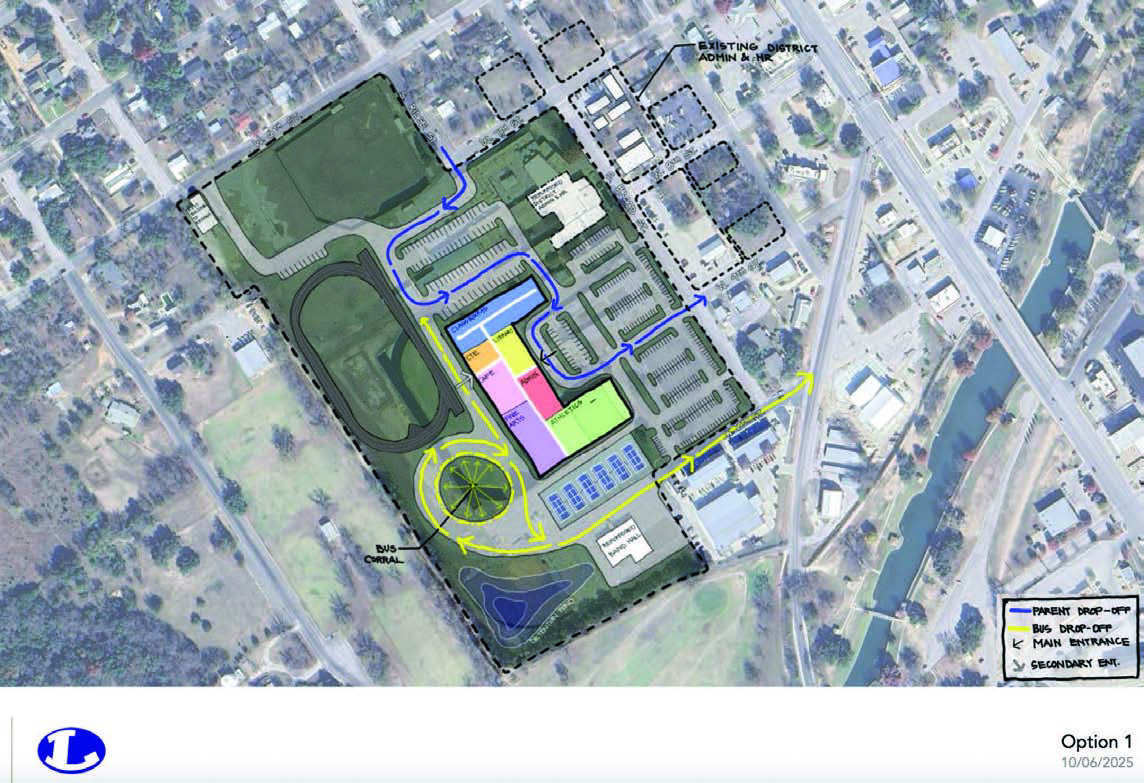
For Option 1, developers would remove the track and football field area behind Bozarth-Fowler Gymnasium, and shift it to the property’s western boundary and about 50-75 yards to the north from its current location.
A new horseshoe-shaped building would be built on the back stretch of the current track and would connect with the Bozarth-Fowler gym, maintaining that facility as part of the campus. The entrance to the middle school building would face South Broad Street, as the current campus does. A two-story academic portion of the middle school building would be located on the north side.
A downside to this construction option is the new school building would be near the current middle school, which would be utilized during construction. Burkhart told board members the closer the new building is to the old campus, the more challenging it is to ensure fire access, clearances and safety for students.
“All that kind of stuff gets logistically more complex when you build that close to the existing campus, which is why Option 2 has some other pros and cons,” Burkhart said. “But the advantage of this [Option 1] is the final phase, the buildout, puts the campus where you want it on the site.”
Board member Randy Morris expressed some concerns with the parent pick-up line that “serpentines” through the proposed parking lot.
For pick-up or dropoff, parents would enter the campus on Seventh Street and snake their way through the parking lot before arriving at the front of the building.
Bell noted the zig-zag line of cars through the property would keep the queue of parent vehicles off city streets.
“We are trying to queue as many cars as we can on the property,” Bell told Morris. “We are also trying to give you significant real estate where we can for any kind of future usage.”
Superintendent Dr. Chane Rascoe asked if this option would allow for some cost savings, considering only one new gym would be needed.
Justin Huling of American Constructors, the district’s construction manager at risk for the bond project, said that is not the case.
“When you look at the other options, that savings is offset by having to move that football field,” Huling said. “When you do the other options and the football field and track get to stay there, there is a savings in that for not having to move it. Within the margin of error of this high level of scope looking at it, all three are about the same range of cost.”
OPTION 2
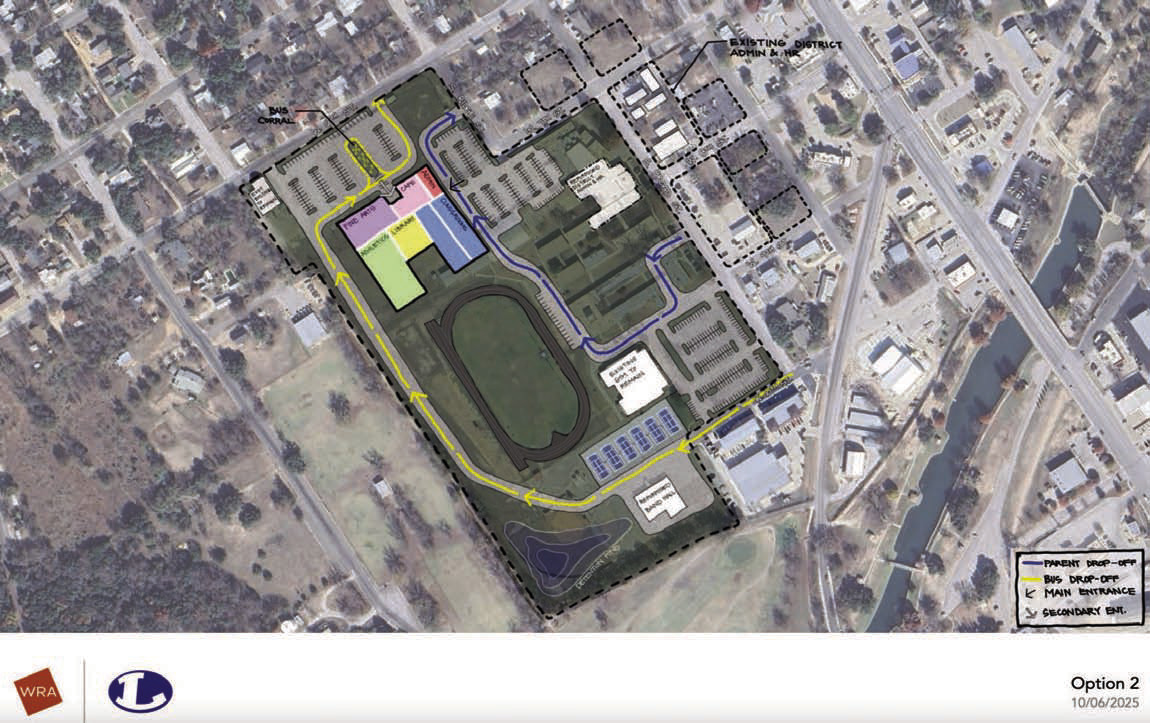
For Option 2, the old “Quonset hut” gym, locker room and weight room would be demolished to make room for the new campus building located directly north of the football field and track. The entrance of the middle school building would remain to the east side, facing South Broad Street.
For student pick-up or drop-off, parents would enter the campus on South Broad and exit onto South Ridge Street.
Option 2 will require the development of two new gymnasiums.
Board President Ryan Shahan asked if there would be cost savings associated with utilizing the Bozarth-Fowler gym versus building two new gyms.
Huling said that is not necessarily the case.
“You are going to have an all-new facility and something that is an aging facility,” Huling said. “The thing about long-term maintenance, that means partway through the life cycle you’ve got long-term maintenance costs versus something that is at the beginning of its life cycle.”
Board member Jeff Rutland expressed concern with Option 2 being in closer proximity to the current campus, which might affect student safety during construction.
Burkhart said the project is flexible to ensure students are not in close proximity to the construction area.
“We have to work with a constructor to go, ‘OK how close do we get? Where is fire access? Do we have to take a few more classrooms to make this work?’ That’s a possibility,” the WRA Architects representative said. “We have to sort through what that means to an operations standpoint of the school. This has different challenges that we have to work through to sharpen the pencil around what needs to happen.”
Shahan agreed with Option 2’s plan to demolish the Quonset hut gym, citing flooding and insulation concerns. On the flip side, Morris and board member Sam Walker felt the old gym still could have a role to play at a new campus.
Bell, however, emphasized the gym would require significant improvements.
“You’d have to tie to the envelope that is there,” he said. “You’d have to upgrade walls, roof, HVAC and electrical. It’d be a major renovation.”
As for the future of the Bozarth-Fowler Gym in Option 2, the space could be repurposed as an 800-seat auditorium with elevated seating, the construction manager said. But the current structure of the building makes it difficult to hang heavy items such as theater lighting or a catwalk. A teardown of the building may allow for a more efficient structure, he said.
“It’s more expensive to tear down and build new, but with this you are not getting the full benefit of what a performing arts center space would be,” Huling said. “You are not getting the height of the structure. There is a lot of acoustical value to a high structure and some other things you would want to hang from the structure.”
OPTION 3
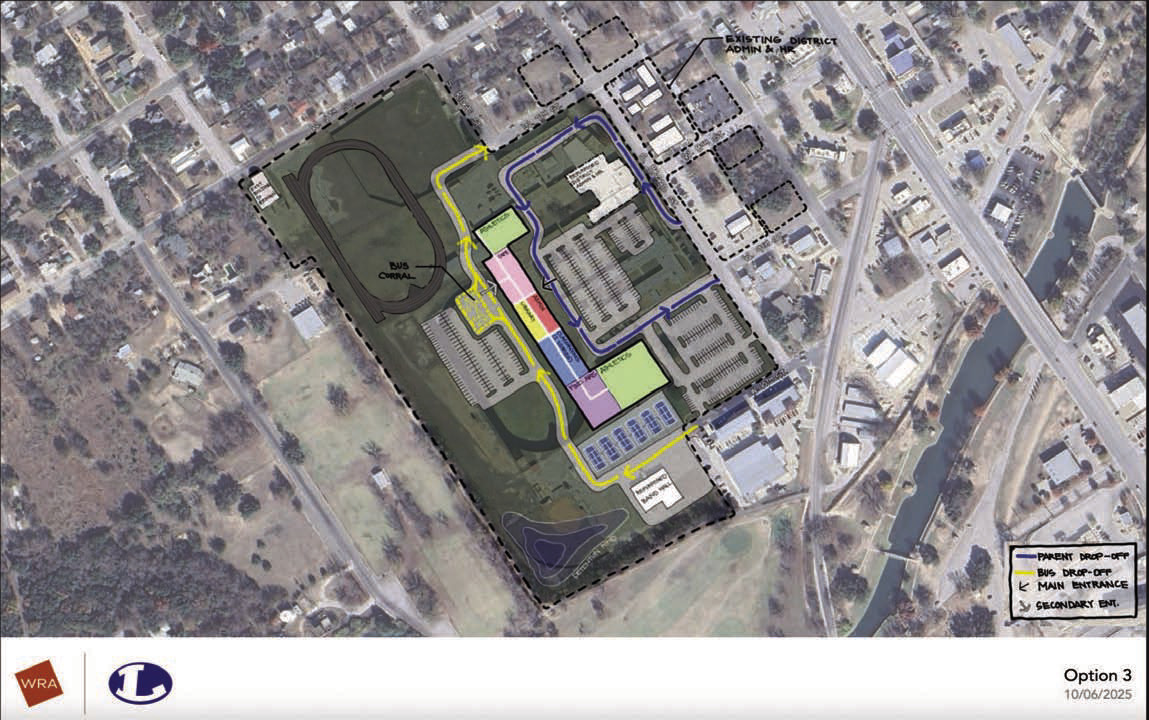
As with Option 1, Option 3 would place a new middle school building on the back side of the current football field and track, shifting the facility to the northwest. The building would connect with the old Quonset gym and Bozarth-Fowler Gym. The main difference between Option 1 and Option 3 is the classroom building itself is thinner, making construction harder for WRA Architects.
“The one thought is, a lot of these spaces get stretched pretty thin, and so when you are thinking about spaces like the cafeteria that you want more of a square and a larger space, you end up with a lot of more classroom-like layouts and hallways,” Bell said.
Shahan reminded his fellow board members that long hallways are not ideal if there were an outside threat to enter the building.
Bell and Burkhart told trustees Option 3 is challenging because it would mean building between two points. Compact buildings, such as are offered with Option 1 and Option 2, allow for a more efficient space.
Morris advocated for repurposing the Quonset hut gym as a new cafeteria, since it is more square in shape.
Burkhart stressed that no matter its future use, that old gym will require a significant number of renovations.
“I’m conflicted as you are,” he said. “I love the underside of it. I think it looks really cool and would be cool to save, but the money you have to put back into that to put it up to current code is a real trade-off.”
NEXT STEPS
Huling told board members Option 2 would be the most expensive project -- $1 million to $1.5 million more than Option 1 and Option 3. Nonetheless, with a new middle school to cost approximately $80 million, the $1 million extra doesn’t mean that much in the scheme of things, he said.
Lampasas ISD also is considering other locations for a future LMS campus. Possible sites include the old middle school and current DAEP building near Badger Stadium, or building on the Lampasas High School property, or using a site at the Business Park off U.S. Highway 183.
Shahan felt the DAEP site is too small a property to contain a football field and track for the middle school, and Walker had concerns with the school being located near a highway as the high school is.
If a new school were developed at the current LMS site, drainage issues will need to be dealt with as standing water is a problem.
Board member Mickey Edwards said he prefers the district to look elsewhere for a new middle school home.
“I’m not totally convinced that this location is the most efficient place to be, with the floodplain, the water issues,” Edwards said. “I know on another site elevation may be a problem, but it’s going to be cheaper to change the elevation there than to redo all of this.”
If Lampasas ISD were to build a middle school in another location, Burkhart reminded board members the district would be tasked with maintaining aging buildings and an empty site.
Lampasas ISD is still several months away from deciding the future of Lampasas Middle School. At the September Facilities Planning Committee meeting, the data presented showed the school district has a bond capacity of $93.265 million with no tax rate increase, and a capacity of $111.085 million with a five-cent increase to the tax rate. Those numbers are subject to change.
The committee’s next meeting will come Oct. 27 at 5:30 p.m. in the LMS cafeteria. The discussion should center around budgets for possible bond projects.
