

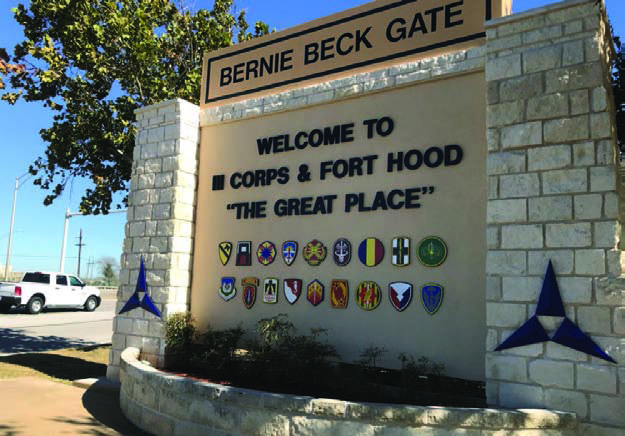
In a speech last week at Fort Bragg to celebrate the U.S. Army’s 250th birthday, President Donald Trump announced Fort Cavazos once again will be known as Fort Hood.
Local veterans like Michael O’Hara, a 20year servicemember in the U.S. Army who sees the military base as a second home, is happy for the name “Fort Hood” to return.
“If it is not strictly political, I like the name going back because to me, Fort Hood always represented the soldiers who have been there,” O’Hara said. “It doesn’t represent politics or race.”
Fort Hood was named after John Bell Hood, a Confederate captain who rose to brigadier general in a year’s time. Prior to the Civil War, Hood served in the Texas frontier while a part of the Second United States Cavalry.
A native Kentuckian, Hood grew frustrated with his state’s neutrality leading up to the Civil War. He opted to resign from his post nine months before the Battle of Bull Run and declared himself a Texan.
Ervin Carr, a retired U.S. Army sergeant first class who served from 1969-1991, believes it was wrong to rid the military base of its original name due to Hood’s Confederate ties.
“That is what happened in this country – it is history,” Carr said. “Regardless, Confederate, Union, it made this country. It made it great.”
Another retired U.S. Army member, known simply as “Peanut” -- who served from 1965 to 1987 -- echoed his friend’s sentiments.
“It has been Fort Hood since day one, so leave it at Fort Hood,” he said. “So it’s a Confederate general, big deal. He fought for his part of the country. Leave it at that.”
After the death of George Floyd in 2020, activists across the country called for the end of “systemic racism.” For some, Confederate statues and bases honoring former Confederate officers were seen as a visualization of America’s discriminatory past.
In 2021, Congress established the Naming Commission to remove any relics associated with the Confederate States of America. The renaming of Fort Hood to Fort Cavazos was one of those projects.
Fort Hood was changed to Cavazos in 2023 to honor Gen. Richard E. Cavazos, a native Texan and the first Hispanic four-star general in U.S. Army history. O’Hara and Carr both hold the former Mexican-American general in high regard. As native New Englanders with no southern ties, they consider themselves Yankees. However, both agree the move to rename forts across the country was for political purposes.
“There was a big wave of folks in the country who wanted all the Confederate soldiers taken out,” Carr said. “I don’t get it, I really don’t get it. Why didn’t they just leave it alone? It cost them what, $40 million to change all the signs and the road signs to ‘Cavazos’? Now, they are changing it back within two years. Who is paying for it?”
Even with the name change, O’Hara says the military base was always known as Fort Hood to veterans.
“I couldn’t get used to calling it Fort Cavazos,” he said. “To me, it’s always Fort Hood. The people around here, it’s Fort Hood. The way I look at the post names, it doesn’t really represent an individual on either side or a race. It represents soldiers.”
Carr said he is unable to find a fellow veteran who supported the name change to Fort Cavazos, but he concedes supporters of the name change must exist.
Although the base will regain the name Hood, it now will be in memory of Col. Robert B. Hood who served in World War I.
“Amid intense shelling near Thiaucourt, France, then-Capt. Hood directed artillery fire under enfilading machine-gun fire,” said a news release from the U.S. Army outlining the new name changes. “After his gun crew was lost to enemy fire, he rapidly reorganized and returned fire within minutes, restoring combat capability.”
Trump announced the renaming of seven military installations during his recent speech at Fort Bragg. All bases will return to their former names, but none will honor Confederate soldiers.
O’Hara believes it’s the name of the post that matters most, not the individual recognized.
“I look at it through people trained there in World War II, Korea, Vietnam,” O’Hara said. “Those people trained there and some of them died. I look at it as a name for soldiers; it’s a soldier’s post. I don’t look at it as a name relating to anybody.”
