



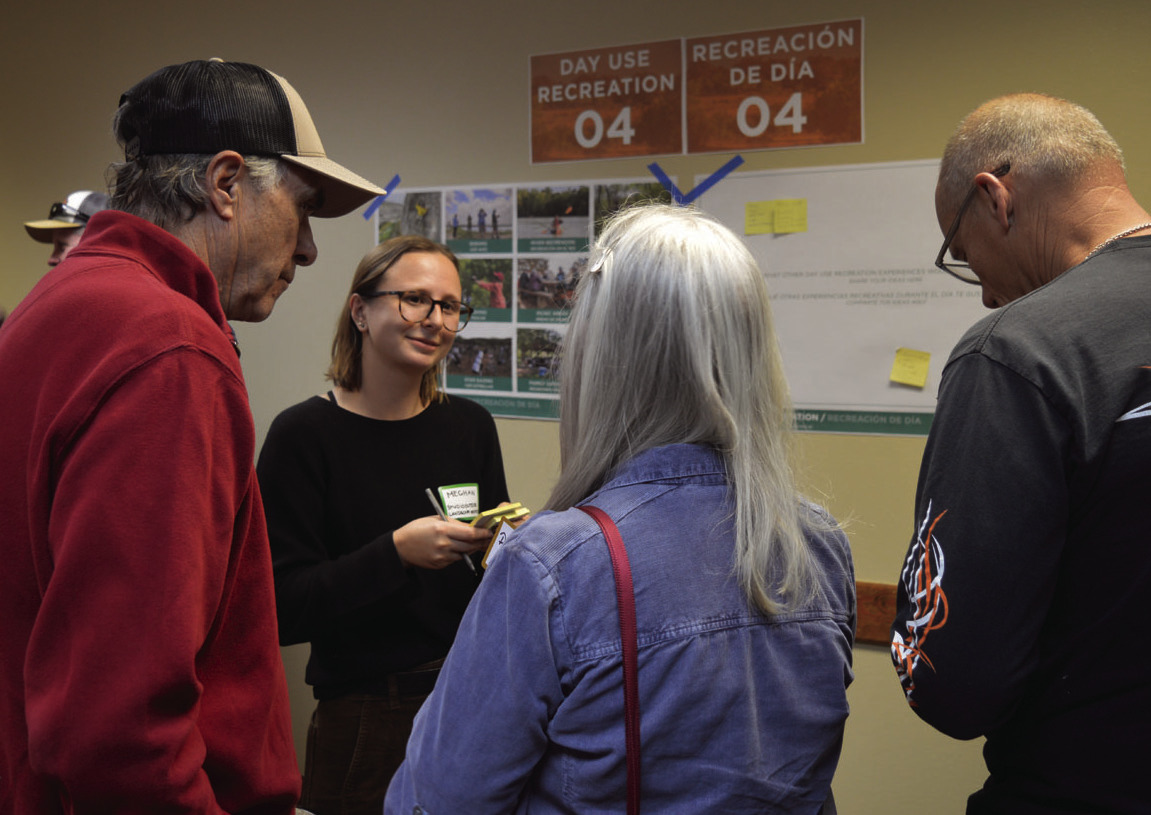
The Texas Parks and Wildlife Department unveiled plans for Post Oak Ridge State Park at a public meeting on Thursday at the Lampasas County Office Building.
More than 70 area residents packed the conference room to learn about the purpose and future vision of the park from TPWD representatives. Attendees were given the opportunity to provide their thoughts on possible park facilities after the 45-minute presentation.
Post Oak Ridge State Park, located in Lampasas and Burnet counties, is just 15 miles southwest of Lampasas city limits. The park was made possible by the Centennial Parks Fund created by the Texas Legislature and approved by voters in 2023.
Centennial Park Planner Maria Malone told attendees the TPWD is looking to increase accessible public land.
“If you add up all the combined acreage of our state parks, it can fit inside Travis County,” she said. “That was just astounding to me when I figured that out. Obviously, we need to work on that, improve on that.”
Malone said the goal is to allow visitors to enjoy the park as soon as possible. Currently, the TPWD is facilitating public day use, public hunts and guided hikes. By September 2026, the TPWD plans to expand public day use at Post Oak Ridge State Park.
“That is going to be when you go online, get a reservation, and can come to the park and enjoy a trailhead and some dayuse hiking opportunities,” Malone said. “There is a current ranch road, a two-track system on the property, so you will be able to hike those to some beautiful destinations.”
The goal is to have the state park fully operational by March 2029. Then, visitors will have the opportunity to enjoy overnight facilities and camping sites. Before that becomes possible, however, water and wastewater systems, increased electricity access, trails and additional roadways must be developed.
Malone said the TPWD is working with studioOutside, a Dallas-based architectural firm that focuses on landscaping, to develop the master plan for Post Oak Ridge State Park.
Andrew Duggan, a partner with studioOutside, told the audience at Thursday’s gathering his team is working extensively to learn more about what lies within the park acreage.
“Our full team has been evaluating different phenomena that are on the site,” he said. “Texas Parks and Wildlife facilitated a bioblitz, looking at the variety of species, plants and animals on the property. And, we continue to learn about these systems, how does the drainage work, how do the ridges and valleys work as a network of spaces.”
Post Oak Ridge State Park shares two miles of Colorado River frontage with Colorado Bend State Park. Nonetheless, Duggan emphasized it is easier to access the river from Colorado Bend State Park than the Post Oak Ridge side because of the sheer cliffs on the east side of the riverbank.
Although TPWD wants to keep the two parks separate for safety reasons, there could be a connection between the two in the future.
“We think these two parks can complement each other and offer experiences that will be unique to each park,” Duggan said. “It is going to be a completely separate entity, two separate state parks that are across the river from each other. Maybe there are some opportunities to enjoy cross-river relationships.”
Post Oak Ridge has several ecological systems working together, Duggan pointed out to attendees. The park has a savanna landscape with oak trees and prairie lands, pristine waterways such as Yancey Creek and the Post Oak woodlands that boast a unique habitat.
“We’ve learned in the last week that some of these trees are 400 years old, and residing on that ridge for that amount of time is an impressive component and an important story to tell,” he said. “We wish those trees could tell us some stories.”
StudioOutside is working to evaluate sites for activities like fishing, paddling, birding and stargazing. Also, the firm is recommending where to place primitive campsites with some utilities, lodging, mini-cabins and spaces for RVs. The architectural firm is eyeing 25 miles of trails for recreational hiking, biking or equestrian use, plus some interpretive trails that provide a learning component.
The main entry to the park will be located on County Road 1405 in Burnet County, the southeast corner of the park. Duggan said the road will be widened to accommodate increased traffic. StudioOutside plans to take advantage of existing ranch roads on the property for the 10 miles of roadway to be developed. The road network will span to the north and west sections of the property.
“We think the southern road would be primarily for day users to get to different trail locations and some overnight destinations along the central road,” Duggan said.
After Malone’s and Duggan’s presentations, attendees were given the chance to meet TPWD representatives and visit several stations illustrating the natural systems, dayuse recreational amenities, trail locations and more.
Lampasas residents interested in providing their thoughts on what should be included in the state park can fill out a survey at surveymonkey. com/r/porsp-survey.
TPWD plans to hold another public meeting in June to provide community members updates on the park’s master plan.
TRANSMISSION LINE UPDATE
The Lower Colorado River Authority’s Transmission Services Corp. and Oncor have proposed a 65-kilovolt transmission line project that would start south of San Angelo and continue eastward to Belton and Temple. Before breaking out into stations at Thursday’s public meeting, the question was posed to TPWD representatives whether the agency is active in ensuring that transmission line will not interfere with the Post Oak Ridge State Park.
Malone assured the audience that TPWD is “working actively on that project.”
“They intend to avoid this park and in general would like to avoid state park properties,” she said. “The conversations of the alignment for that are ongoing. We are not making recommendations for the alignment.
“We are recommending we don’t want it in state park property to preserve the experience,” Malone told the audience.
