

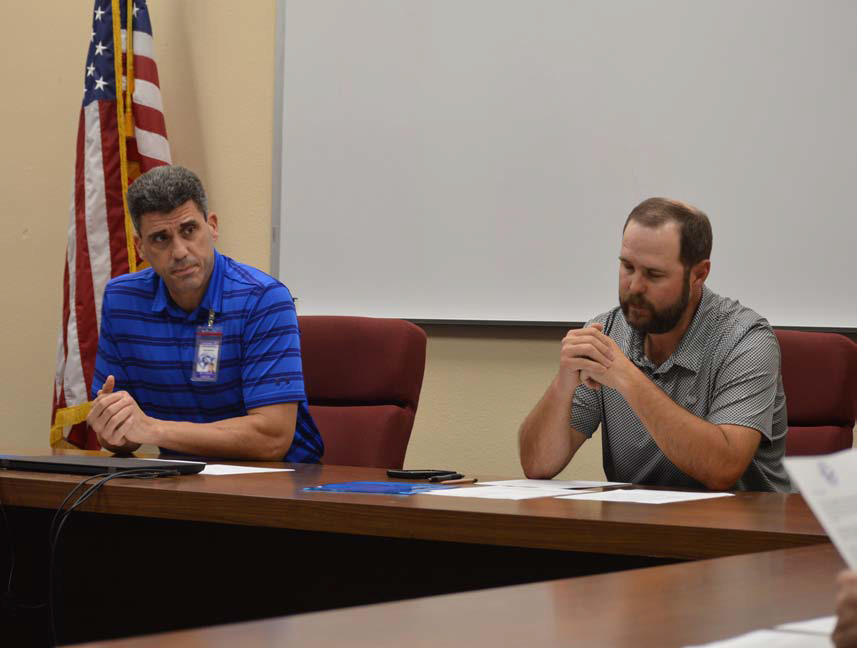
Lampasas ISD is asking voters to approve a $139.63 million bond that would raise the district’s tax rate by 8.51 cents. The district’s Board of Trustees officially called for the May 2 bond election in its regular meeting on Monday.
Board President Ryan Shahan believes the bond not only solves the need for a new Lampasas Middle School campus but addresses other district facility improvements that have not been completed.
“I believe we have done our due diligence in finding things that need to be done that we don’t really have the funding for right now, but we need to complete them in a timely fashion,” Shahan told the Dispatch Record.
The bond is composed of three propositions.
Proposition A totaling $115.55 million includes a new middle school campus, demolishment of the old campus, safety and security upgrades for the district’s three elementary schools and approximately 35 new school buses.
Proposition B equaling $21.58 million includes traffic solutions at Lampasas High School and Taylor Creek Elementary School, a band/ fine arts allowance, a new multipurpose athletic facility and a band practice open-air pavilion.
At $2.5 million, Proposition C includes the field and track repair/ replacement at Lampasas High School and Badger Field maintenance items.
LISD’s tax rate has dropped 41.5 cents since the 2017 rate of $1.43. If the bond is approved by voters, LISD’s tax rate would rise to $1.1003 per $100 in property valuation. For the average home in the school district valued at $324,925, the monthly tax impact would be an additional $13.11 per month.
“We have the opportunity right now to only go up 8 cents, which is roughly a 10% increase in our total tax rate, and still be able to accomplish a lot of things that are good for the district,” Shahan said.
Since the bond planning process started with a facilities review provided by WRA Architects in April 2025, the focus for trustees has been a new LMS campus to be situated on the site of the current campus on Broad Street.
“The location is ideal because it is in town,” Shahan said. “There are a ton of kids who get to school by walking or riding a bike to school – very convenient for those purposes. On another idea, it is very easy to get in and out of when going to pick up your kids. It has multiple access points and multiple exit points.”
Throughout the bond planning process, the price of the middle school has fluctuated from around $94 million to $112 million. Ultimately, the price budgeted for the project is approximately $104 million.
The price of the new campus changed as the district altered the programing to ensure it fits a capacity of 1,000 students in academic areas and 1,100 students in core areas like the cafeteria.
Shahan believes the board budgeted as conservatively as it could without the risk of under budgeting.
“We are trying to come up with a cost number before we get our money,” he said. “So, you don’t want to use a cost number that is too low. You get the funds, and then two years down the road realize you are 20% under budget.”
Originally, trustees had hoped to present the new campus plan without proposing an increase to the tax rate. The district could have spent approximately $100 million without a tax hike. When it became apparent that dream was unlikely, Lampasas ISD sought the opinions of the district’s 40-member Facilities Planning Committee -- composed of district staff, administrators, parents and community members.
During bond planning committee meetings in the fall, members approved of bond proposals that would increase the district’s tax rate to pay for a new middle school campus. Members also agreed to a tax hike for other capital improvement projects featured in the bond propositions.
Shahan credited community members who played an integral role in the inclusion of traffic solutions at the two campuses.
The board president said the nearly $140 million bond is not full of fluff but contains vital needs for the district that cannot be afforded in the annual operations budget.
“The more you identify how far behind we are on capital outlay, things that need to be done, and the community tells us they seem to be OK with a tax increase, then we decided to put that forward,” Shahan said.
When the Texas Legislature passed House Bill 2 last year, it included a $55 increase to the basic student allotment, the first since 2019. During that period when schools did not receive extra funding from the state, Shahan said the district had to be smart about managing its budget.
In the 2022-2023 fiscal year, trustees approved a budget with $37,765,050 in general fund expenses, including $18,349,128 in instructional costs and $5,045,408 in planned maintenance.
In the most recently approved budget featuring $47,166,318 in expenses, the instruction portion has risen to $25,245,935, while plant maintenance grew to $5,697,524.
“Over that period, we tightened the budget in departmental spending and some discretionary capital outlay while giving raises to address teacher pay levels,” Shahan said. “ESSR was also a federal program that helped to fund intervention and some teacher salaries associated with COVID-related educational setbacks. That funding source is now gone, yet we retained all of those teachers/interventionists, hoping that the state would make up the funding by addressing actual needs.”
With the school district now funding support staff who previously were funded by federal grants, the district is facing a budget deficit.
LISD currently spends around $1 million for interventionists, aides and other support staff. At the board’s February meeting, Director of Accounting Wanda Bunting projected a $1 million to $1.2 million deficit for this year, less than the originally feared $3 million deficit.
Shahan, however, said the district cannot continue to dip into its savings account and fund improvement projects that cost millions. The board president said he is concerned with how schools will be funded in the future as Gov. Abbott, who is seeking a fourth term, has floated the idea of ending school property taxes. Instead, funds would be distributed solely from the state.
“That is the worst-case scenario for schools, because now we are 100% funded from what the legislature in Austin says we should do in Lampasas County and the city of Lampasas,” Shahan said. “Everybody is different, that is why I believe it is important we try to retain as much local control over our finances as we can.”
Also, Shahan is concerned the district will lose its ability to effectively pass school bonds. In the recent legislative session, House Bill 275 proposed changing the voter approval threshold from a simple 50% majority to 60% voter approval. Shahan is worried these discussions will ramp up.
“It is a big reason why the board ultimately was OK with a tax increase, because we want to put it to the voters and let them make the call on building these facilities now, because it may be the last opportunity they get,” Shahan said.