

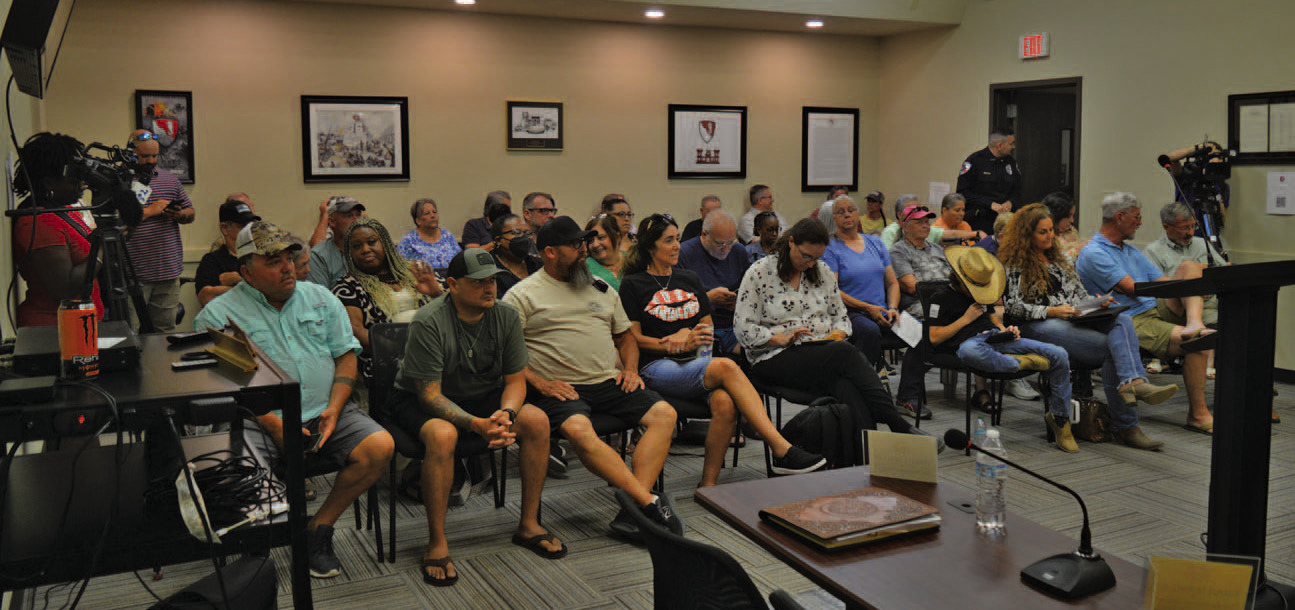

More than 50 Kempner Water Supply customers attended Tuesday’s meeting of the Kempner City Council to express their dissatisfaction with the supplier’s water quality.
State Reps. David Spiller (R-Jacksboro) and Brad Buckley (R-Salado) were present to hear from those in attendance at the two-hour public input session about ongoing issues with KWSC.
KWSC members have voiced concerns about their water having poor taste, odor and discoloration.
Due to heavy flooding in May at Stillhouse Hollow Lake -- KWSC’s production site -- the water supplier has struggled to remove color and odor from the water.
Last week, the Texas Commission on Environmental Quality issued a boil water notice for the entire KWSC system after the state agency found chlorine residuals below the state-mandated 0.5 milligrams per liter. On Monday, KWSC converted the disinfectant used in its system from chloramine to free chlorine after receiving direction from the TCEQ.
KWSC customers remain under a boil water notice.
Although the city of Kempner does not govern or have oversight of the water supply corporation, Mayor John Wilkerson had offered a public session so elected officials could meet face-to-face with residents and hash out some solutions.
“This City Council is willing to work with the Kempner Water Supply Corp., our state elected officials and anyone else that we need to work with to find an end of means to this problem,” Wilkerson said to start Tuesday’s meeting.
LAWMAKERS OFFER THOUGHTS
State Rep. David Spiller spoke for approximately 20 minutes, highlighting possible solutions to KSWC’s ongoing troubles. Spiller said he has been in contact with KWSC General Manager Bruce Sorenson, the TCEQ, and Texas Water Development Board to stay informed on the matter.
Spiller said engineers have offered two projects as a means to remedy the situation. The project that affects those in Lampasas County is a pre-treatment of the water in Stillhouse Hollow Lake to remove debris and other impurities.
“There is an estimate of a cost from the engineer on the cost of what they need to do [in Stillhouse],” Spiller said. “It is my understanding there are several problems when they pull raw water out. If it goes untreated or not treated enough, they have to pump it a great distance, and sometimes that makes it more difficult to treat the water when they get it.”
Previously, Sorenson told the Dispatch Record such a “water clarifier” would cost between $18 million and $20 million. During Tuesday’s meeting, Spiller confirmed the cost at $18.6 million, based on the engineers’ estimate.
The state representative noted that KWSC has more than $30 million in debt, and plant upgrades would add to that number. Nonetheless, there are ways the water supplier could improve the system, Spiller said.
The KWSC has claimed its status as a non-profit corporation limits its availability to seek grant funding. Spiller told meeting attendees that KWSC received grant funding in 2006 and 2008 for a treatment transmission project.
Spiller also said KWSC is eligible for funding from the Drinking Water State Revolving Fund, Clean Water State Revolving Fund, Economic and Distressed Area Program, and State Water Implementation Fund – of which Spiller is a committee member. Although eligible for these grants, KWSC has yet to apply for them, the state representative said.
“Even though they missed the window here, there are some things under certain circumstances you can apply for emergency funding,” Spiller said. “But, you have to apply to get it, and so far that hasn’t been done.”
Also, Spiller said the Texas Water Code allows water supply corporations like KWSC to convert to a special utility district – which provides more financial flexibility.
Spiller said the Texas Legislature is doing all it can to fund water projects.
“We, through the legislature, have funded more water-related projects in the last two years, if not four years, than we ever have before,” he said. “My concern is the funding is there, the ability to get funding for what you need is there, but you need to ask for it.”
State Rep. Brad Buckley made brief comments at Tuesday’s meeting. He told those in attendance the issue with KWSC is not isolated to Lampasas County.
“The momentum we can gain is the fact it is not only the Kempner problem; it is the Salado problem, it is what I call the Youngsport problem, which is where I grew upon in southwest Bell County,” Buckley said.
The Salado Water Supply Corp. also has battled discoloration, odor and taste issues. According to KCENTV, SWSC’s general manager has attributed the problem to KWSC.
RESIDENTS OFFER THEIR INPUT
Kempner resident Gretchen Simpkins was the first of more than two dozen individuals who voiced concerns about the water. Simpkins told elected officials and City Council members she never would have moved to Kempner if had been aware of the water situation.
Simpkins said she has battled immune issues and lost a dog due to the poor water quality. Others at Tuesday’s meeting echoed similar concerns.
“We used to live in Killeen,” Simpkins said. “My husband was retired military. Why we moved out here, I still don’t know.”
Debroah Scibor brought a photo of her bathtub filled with murky water. A Detroit native who has moved 27 times, Scibor said the situation with the KWSC is like nothing she has experienced before.
“I have a 6-year-old grandson,” she said. “How am I supposed to give him a bath? How am I supposed to wash and clean my house? The laundry, why do it.”
Scibor believes KWSC can do more to upgrade its lines, something Mayor John Wilkerson agreed with.
The mayor said he would like to play a role in upgrading KWSC lines within the city limits, which is permitted by law.
“Under Chapter 67 of the Water Code, it specifically gives water corporations the chance to contract with other governmental entities, including cities, to do just that,” Spiller said.
Kempner-area resident Jody Rumph has started a petition on Change.org titled “Kempner deserves drinkable water.” Rumph said the KWSC bylaws allow a special meeting to be called if onethird of the 5,000-plus members sign a petition. Also, she believes more needs to be done to help the elderly who are suffering from ongoing boil water notices.
“There is a need,” Rumph said. “I have neighbors who are disabled and cannot boil their water. It is too physically difficult for them to lift the pots. They are on limited incomes, and I have been taking care of my neighbors.”
Thomas Schilpp, a U.S. military veteran, said he has lived in the Kempner area since 2002. Like many other veterans who spoke Tuesday night, he said the KWSC water is inferior to what is found in war-torn countries in the Middle East.
“I have my wife and two daughters that are now gone that got thyroid issues after we moved and lived in Kempner for more than 10 years,” Schlipp said. “There is a serious problem, and this community is going to turn out like Flint, Michigan, if something isn’t done by somebody.”
Renee Simons told the audience that when she moved to the area in 1995, the water was “fantastic.” She believes mismanagement of funds has contributed to the poor water quality.
“I don’t think they have any plans installed to take care of all the piping that needs to be taken care of and looked at immediately,” Simons said. “It seems these issues come when we have very hot weather, dry weather and the heavy rainfall.”
At the end of the session, Wilkerson asked the public if the council should place an item on the agenda to conduct sporadic water quality testing in the city via a private independent contractor.
Many in attendance claimed the TCEQ sample results do not show all that is wrong with the Kempner water, and they voiced support for the idea of independent water testing.
