

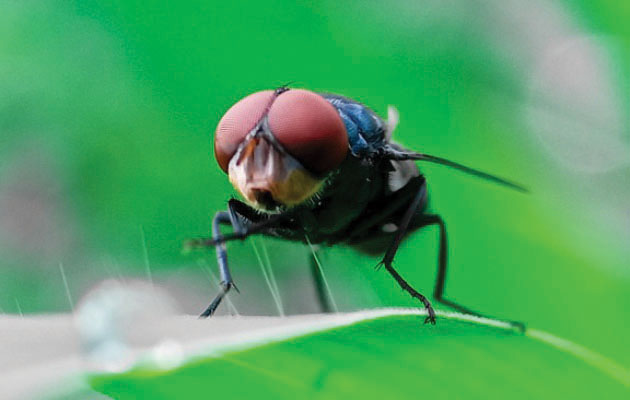
Many ranchers fear it will only be a matter of time before the New World screwworm appears in the Lone Star State. Just last month, the parasitic fly was discovered 70 miles south of the Texas border in the Mexican state of Nuevo León.
It has been more than 50 years since Lampasas County ranchers have battled the New World screwworm. For Lampasas County Farm Bureau board member and former Texas Farm Bureau state director Mickey Edwards, the story is all too familiar.
“If we have a warm fall, they could be here before really cold weather,” he said of the parasites’ arrival. “If it gets cold early, that will sure help slow them down. If we have significantly cold weather, then we won’t have problems until spring.”
The New World screwworm is a parasitic fly that lays eggs in the living tissue of fresh wounds in warm-blooded animals. Once hatched, larvae feed on the living tissue of the host.
Until its eradication in the 1960s, screwworms had significant impacts in Texas, the nation’s largest cattle producer.
In 1935, screwworm infestations caused 180,000 livestock deaths. During the 1950s, Texas ranchers treated around one million cases per year, with thousands of cases reported at the height of the outbreak in 1962.
Dealing with initial infestation
Edwards remembers taking steps as a child to help livestock infected with the screwworm.
“We started out using a black-tar type of ointment that we would rub into the wound, and that was not really effective,” Edwards said. “They came out with an aerosol. There was a yellow and a green one as far as the color, and we would spray that on the affected area, and it was very effective unless it had gone too long on the animal.”
It wasn’t uncommon for Edwards to be handling a significant number of dead livestock during the screwworm infestation.
“My job when I was 7 or 8 years old was to take the dead animals away from the barns,” he said. “So, we probably lost 10%, if we had something in the spring or summer. Some people lost more. It was devastating.”
Edwards said the screwworm forced ranchers to change how they lambed, kitted or calved out, with many opting for the wintertime when screwworms are less prevalent.
A key to combating the screwworm was ensuring livestock were checked daily.
“We had to check our sheep, goats and cows regularly because if they go more than a day or two without being checked and they have the screwworm, it will kill them,” Edwards said.
Livestock were not the only victims, however, as Texas wildlife also was affected. In some heavily infested areas of the state, the fawn mortality rate reached 75%-80%.
“The losses were significant, especially wildlife,” Edwards recalled. “Deer, they will have their fawns in the early spring and are susceptible just like livestock. Our deer and wildlife population really increased after we eradicated the screwworms.”
Eradication efforts
The screwworm was eradicated thanks to a sterile insect technique. According to the U.S. Department of Agriculture’s Animal and Plant Health Inspection Service, the sterile insect technique uses gamma radiation to radiate New World screwworm pupae and create sterile male flies.
When released into the wild in mass, these sterile flies mate with wild female flies that lay unfertilized eggs. Since female New World screwworm flies typically mate just once, the population begins to reduce before it is completely eradicated.
Gov. Greg Abbott and U.S. Secretary of Agriculture Brooke Rollins announced earlier this year that USDA is set to invest $750 million to build a sterile fly production facility to eradicate the screwworm. Although these efforts are underway to combat the parasitic fly, Lampasas ranchers should be aware of its ongoing movement and potential spread.
“It’s kind of undetermined how significant and widespread it is going to be, but it is definitely a concern,” Edwards said of a potential infestation. “If you have even a 1% loss in livestock, that’s a tremendous number. When a baby calf or young calf is worth $2,000, you lose one of those, you are losing a lot of money.”
The sterile insect technique is not the only option being pursued to combat the New World screwworm. After receiving authority from the U.S. Department of Health and Human Services to use animal drugs to combat the screwworm, the FDA has conditionally approved the use of Dectomax-CA1, an anti-parasitical injectable drug. It will be used in the battle to treat larvae infestations and to prevent re-infestation for 21 days.
The FDA reports that the drug was able to receive conditional approval because it has been proven safe with a reasonable expectation of effectiveness.
In July, Texas Agriculture Commissioner Sid Miller released a plan for a new and improved chemical lure, named TDA Swormlure, designed to attract and kill adult screwworm flies.
Also, Abbott has directed the Texas Parks and Wildlife Department and the Texas Animal Health Commission to establish a joint New World Screwworm Response Team.
Edwards said he has heard rumblings that the New World screwworm has been found in South Texas, but those rumors remain unconfirmed.
The Texas A&M AgriLife Extension Service says the New World screwworm can be identified by its blue blow flies with three distinct stripes that run down the top of the fly behind the head with large orange eyes.
Signs associated with screwworm infestation in animals include foulsmelling wounds with maggots; biting or licking at wounds; lesions in navels, ears, dehorning or branding sites; and shaking heads or acting agitated.
Lampasas County AgriLife Extension Agent Heath Lusty said livestock producers should have the New World screwworm on their radar.
“It is like everything else -- you need to be aware; awareness is a big deal,” Lusty said. “It is something you don’t want to be caught by surprise. I don’t think anybody needs to freak out and completely panic -- just need to be aware, educate yourself and look for what the signs of it are.”
