

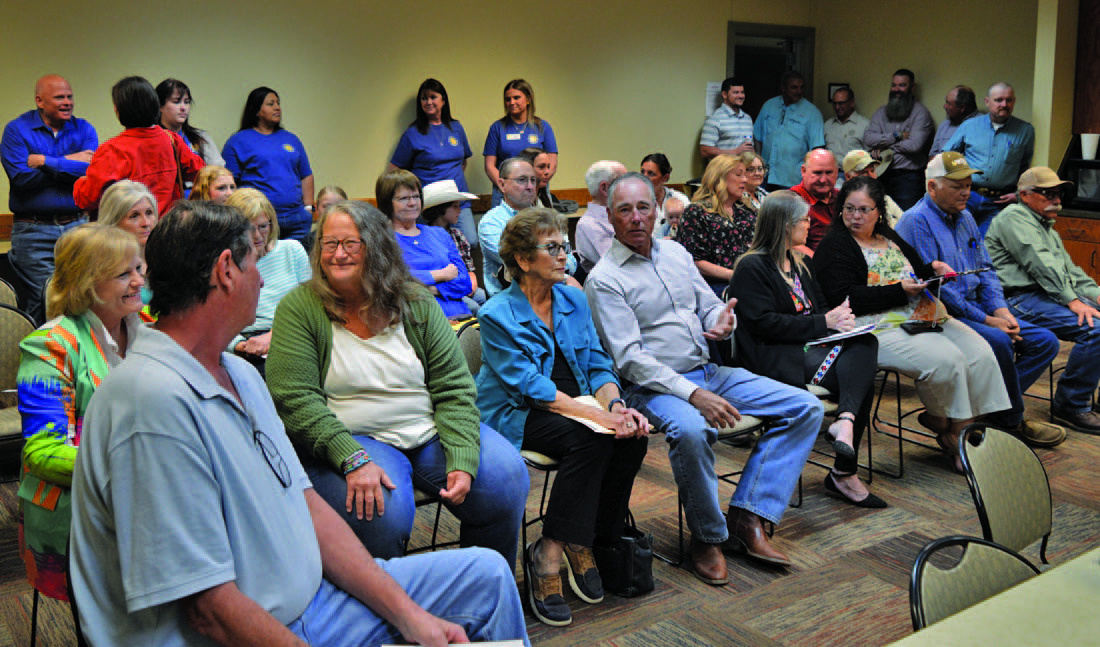
Lampasas County residents were not shy to offer thoughts on a proposed 26.9-mile railroad line. Numerous citizens showed up at Monday’s Lampasas County Commissioners Court and Lampasas City Council meetings to voice their opinions.
Dozens of area landowners told government officials how they would be affected by the project, which has been submitted to the Surface Transportation Board.
Texas Materials Inc. has proposed reconstruction of 12.5 miles of line on the right of way of a former railway and seeks to develop 14.4 miles of new rail line. The line would haul aggregate from four Burnet County-based quarries to eastern Lampasas County. The company is a subsidiary of CRH Americas Materials, which is a part of CRH – a global building materials firm headquartered in Dublin, Ireland.
Texas Materials estimates an average of 1.64 trains per day would utilize the rail line. Trains would contain 120 open-top hopper and gondola cars pulled by four locomotives. The estimated length of the train is 6,400 feet.
Local government agencies, elected officials and Native American tribes were notified of the rail project in a March 4 letter from the STB’s Office of Environmental Analysis. An updated version of that letter with corrected mapping details was sent on March 14.
Landowners indicate they have not received any notification from the company about the project that might go through their property.
COMMISSIONERS COURT DISCUSSION Lampasas County residents packed the conference room inside the county’s annex building to explain their frustrations with the proposed project.
Precinct 4 Commissioner Mark Rainwater told residents he is here to help.
“I know there are lots of concerned constituents, and I am one of them,” he said.
One of those who offered comments was Gilbert Riojas. Originally from West Texas, Riojas said he has been ranching in Lampasas and Burnet counties for more than 30 years. He listed potential impacts on his property if this project were to go through.
“We would be affected at the very north end of this rail line, because at the southwest border of our property they would take away – we would lose three-quarters of a mile of Sulphur Creek,” Riojas said. “That little bend we would lose. The Clarys and I have been the only owners of that property since 1953.”
Riojas told the Commissioners Court he has friends at the state and federal levels of government, including Texas Secretary of Agriculture Sid Miller and former governor Rick Perry. He encouraged collaboration between citizens and the court to address this issue.
“Your powers may be limited as to what you can do, but we need you to help us get organized – create a public forum,” Riojas said. “I will commit the time, the effort and the money to mobilize a committee.”
Lauren Crawford, another resident who is a part of a ranching family in Lampasas County, also offered comments to commissioners. She expressed fears the ranch that has been in her husband’s family since the 1800s would be sliced in half, affecting cattle and hay production.
“I just don’t understand when corporations could come into Texas and take land, that doesn’t seem very Texan -- and, for personal gain and no benefit to the communities they are going to be destroying,” Crawford said.
Lampasas resident Stephanie Fitzharris said she has assisted in establishing a Facebook page to spread word of the proposed project. She is concerned how the rail project might affect water lines along U.S. Highway 190.
“My concern primarily is water,” Fitzharris said. “The Kempner water line seems to follow [U.S.] 190. I’d like to see an overlay of that. My concern is safety. If there’s a fire on this train or if it breaks down over the water supply and there is a water leak, what is the worst-case scenario and can they go over that water line.”
Renee Purdy, a newer member of the Lampasas County community, encouraged residents who don’t own property to speak out against the rail line project.
“The thing about Lampasas is we are a community, and we have to have people who don’t have this going through their land speak up,” Purdy said. “If we bow down to elite, big-powered Fortune 500 companies, they will continue to come after Lampasas.”
Burnet County Precinct 2 Commissioner Damon Beierle attended Monday’s Commissioners Court meeting in Lampasas. He noted the two commissioners courts would be working hand-in-hand on preventing the rail project.
“We are going to become one when it comes to these two counties in trying to fight this and learn more,” Beierle told the audience.
After public input, Commissioner Rainwater said he had talked with the STB Office of Environmental Analysis’ Adam Assenza, who said the project is in its early stages.
“The Surface Transportation Board, they are the ones doing the study right now,” Rainwater said. “This morning, he was telling me, ‘We are looking for does it affect school buses, does it affect waterways. Just off the top of my head, I told him it does affect school buses.”
Lampasas County Judge Randy Hoyer told those in attendance the community has the support of the court.
“Without a doubt, the Commissioners Court has heard you loud and clear, and we will definitely work with you, the citizens of Lampasas County, as well as Burnet County and do our best here,” Hoyer said.
LAMPASAS CITY COUNCIL DISCUSSION City Council Chambers was packed with residents Monday evening who gathered to voice their thoughts on the possible railroad project. Nothing but dissent and disapproval was expressed.
Mickey Edwards, a property owner in eastern Lampasas County and a member of the Lampasas ISD Board of Trustees, was the first person to address the council.
“I know the City Council doesn’t have a lot of impact on this issue on the railroad, but it will impact our citizens and our traffic patterns and our safety, so I’m speaking in opposition,” Edwards said. “I think it’s a project that doesn’t need to happen. It’s a private enterprise; it’s not a government entity … When you think about [U.S. Highways] 183 and 190 and the property owners, it’s going to have a great impact on our community. And if it impacts our community and our citizens, it impacts the city.”
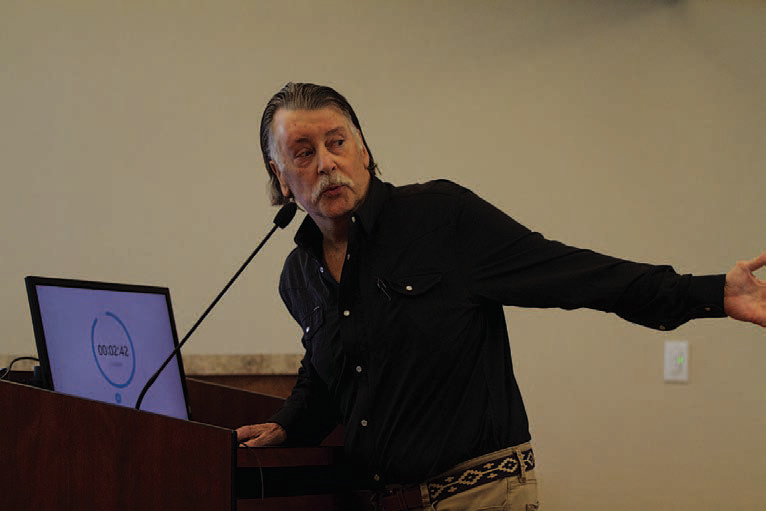
Perhaps the most demonstrative comments came from Bill Hinckley. His Bar H Bar Ranch is located off U.S. Highway 281 south of Lampasas.
“I would like to take 10 seconds of my three minutes to thank everyone in this room,” he said. “It has been inspiring in the twoweek period that we’ve had to see this community come together against billiondollar adversaries with deep pockets.
“What we have here is kind of heavy-handed and sleezy to my mind,” Hinckley said. “These people tried to rush this through the federal government, and their plan after I’ve talked to them and my lawyers have talked to them, it is obvious. They were trying to seek approval and then tell us about it.”
Hinckley outlined what he thinks Lampasas is up against.
“They know what they’re doing,” the landowner said. “We were treated like a bunch of hillbillies that weren’t going to figure it out, and we have figured it out. Please just have our eyes open to our adversary because it is huge.”
A third speaker was Stephanie Ahr, who has started both a Facebook group and a petition that has garnered over 1,000 signatures protesting the railroad project.
“I am a sixth-generation settler here in Lampasas,” she said. “I believe that the proposed Texas Materials railway will significantly impact on the city of Lampasas despite claims that it will primarily affect only rural areas. While the route may technically remain outside the city limits, its proximity and multiple highway crossings will create substantial disruptions for Lampasas residents, businesses and commuters.
“Frequent train crossings will create delays, increase traffic congestion and compromise public safety,” Ahr said.
She also said property values and future development would be affected by this proposed rail line.
Concerns also were voiced over the environmental impact of the project, with waterways and wildlife to be negatively affected if the tracks are put down.
After 10 different members of the public spoke, the City Council also heard from County Commissioner Mark Rainwater who voiced his objections.
Later in the meeting, the council did not take any action on the railroad project. City Manager Erin Corbell said the only action the council could consider at this time would be to decide whether to submit an environmental response to the Surface Transportation Board.
Councilwoman Cathy Kuehne said the City Council will support the other governmental bodies around Lampasas and Burnet, and members concurred they would be in opposition to the railroad project at this time.
Corbell said she would stay up to date on the project and bring details to the council as they become available.
NEXT STEPS
Residents who believe they would be affected by the Texas Materials project are encouraging one another to collaborate on the Facebook page “Burnet/Lampasas County Quarry Train Info” and the “Burnet/ Lampasas County Quarry Train Discussion Group.” Combined, the pages have amassed 1,400 followers thus far.
Assenza, of the STB Office of Environmental Analysis, told the Dispatch Record that an environmental review for a project like the one proposed by Texas Materials is a one- to two-year process. The STB has yet to commence its review and is currently receiving environmental comments, he said.
More than 115 comments have been submitted by community members and government officials to the STB thus far, Assenza said.
Residents can submit comments by visiting STB’s website at stb.gov and clicking the “File an Environmental Comment” tab.
